The Freedom to Stay
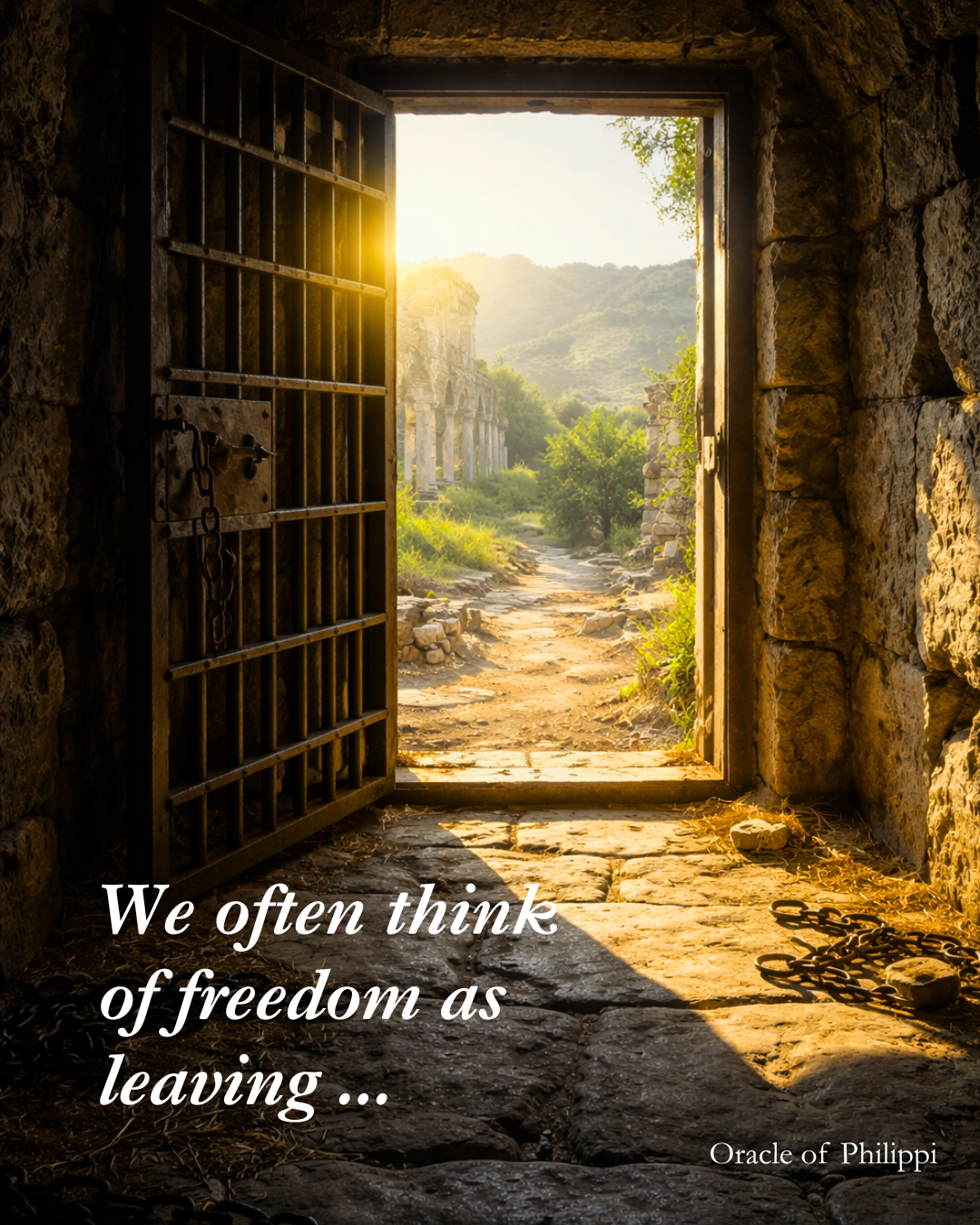
When we think of freedom, we almost always picture movement. It may be an unlocked gate, a clear path, a chance to walk away from whatever has bound us.
Freedom, in our imagination, looks like leaving.
In the Roman world, freedom was prized, celebrated, and fiercely protected. But it was also carefully defined, regulated, and limited. And in Philippi—a Roman colony planted firmly in Macedonian soil—the word carried particular weight.
Freedom there wasn’t merely an idea. It was a legal status, a social marker and above all, a privilege tied to citizenship and allegiance.
After the Battle of Philippi in 42 BCE, Roman veterans settled the city. They were granted ius Italicum—a rare legal distinction that gave its citizens the same rights as those living on Italian soil. Philippi’s elite spoke Latin. They modeled their civic life on Roman customs. They honored the emperor’s festivals. To them, freedom meant belonging to Rome.
But for everyone else—slaves, foreigners, laborers—that same word sounded different. Freedom was something other people possessed. It was external, conditional, and always dependent on circumstances.
Until Christianity entered the city.
The gospel defined freedom in a way that did not originate in law or empire. It offered liberty equally to slave and free, Jew and Gentile, male and female. It named a kind of release no magistrate could grant and no imperial decree could revoke.
This freedom was rooted in the heart—the soul.
This difference comes into sharp focus during the prison scene in Philippi when an earthquake shakes the foundations of the jail. Doors swing open, and chains fall away.
This would seem to be the moment to run. Escape is now possible. Authority has been disrupted. Opportunity has arrived.
And yet, Paul and Silas remain. More incredibly, so do the other prisoners.
From a Roman perspective, this makes no sense. Freedom, as Rome understands it, tries to escape danger.
But Paul and Silas—and others who have come to believe—work from a different framework. Their freedom doesn’t depend on circumstance or rise and fall with architecture or authority.
It exists even with wrists still marked by iron chains, even beneath the watchful eyes of empire.
“If the Son sets you free, you will be free indeed.”
This is lived reality, and the jailer witnesses it firsthand. He has spent his life enforcing Rome’s order. His sense of safety depends on maintaining systems that punish failure harshly.
When the earthquake strikes, he assumes his world has collapsed. Escaped prisoners means disgrace. Disgrace means death. He believes he has already lost everything. But then he sees the men who should’ve run are still there.
That the prisoners are calm undoes him. Their quiet presence exposes something he cannot unsee, which is that his own life, shaped by obligation and survival, feels far less free than theirs.
This realization becomes the turning point of his story, drawing him to a new allegiance, and toward a freedom that doesn’t depend on rank or outcome, but on peace.
Rome defines freedom as escape from constraint.
The gospel reveals freedom as faithfulness within it.
That night in Philippi, the believers demonstrate a strength deeper than resistance. They stay—not because they are trapped, but because they are free enough to choose obedience over self-preservation.
Their choice unsettles everything.
And it still speaks.
Because we, too, tend to equate freedom with leaving. We imagine liberation as walking away from a job, a role, a relationship. Sometimes that is what wisdom requires. Sometimes the open door is the path God provides.
But not always.
There are moments when staying is the braver act. Moments when endurance becomes testimony. Moments when staying reveals a deeper liberty than escape ever could.
The Philippian prison reminds us that freedom isn’t measured by how quickly we exit difficult places. It’s measured by whether our hearts remain unchained while we stand in those same places.
Sometimes freedom looks like stillness, or courage, or love.
Sometimes, astonishingly, it looks like staying in a broken place with an open door, because peace has already taken root inside you.
