The Philippian Jailer and the Earthquake That Changed Everything
When we imagine ancient prisons, we tend to picture shadowed cells, heavy iron doors, and chains that clink against stone. In the Roman world, jails were more than holding places for the accused. They were instruments of control.
In Philippi, the prison stood near the forum, a visible reminder that Rome’s justice was always close at hand. The jailer—often a retired soldier—was a man formed by discipline and loyalty. His orders were simple: keep the prisoners secure, keep the peace, and keep himself above reproach.
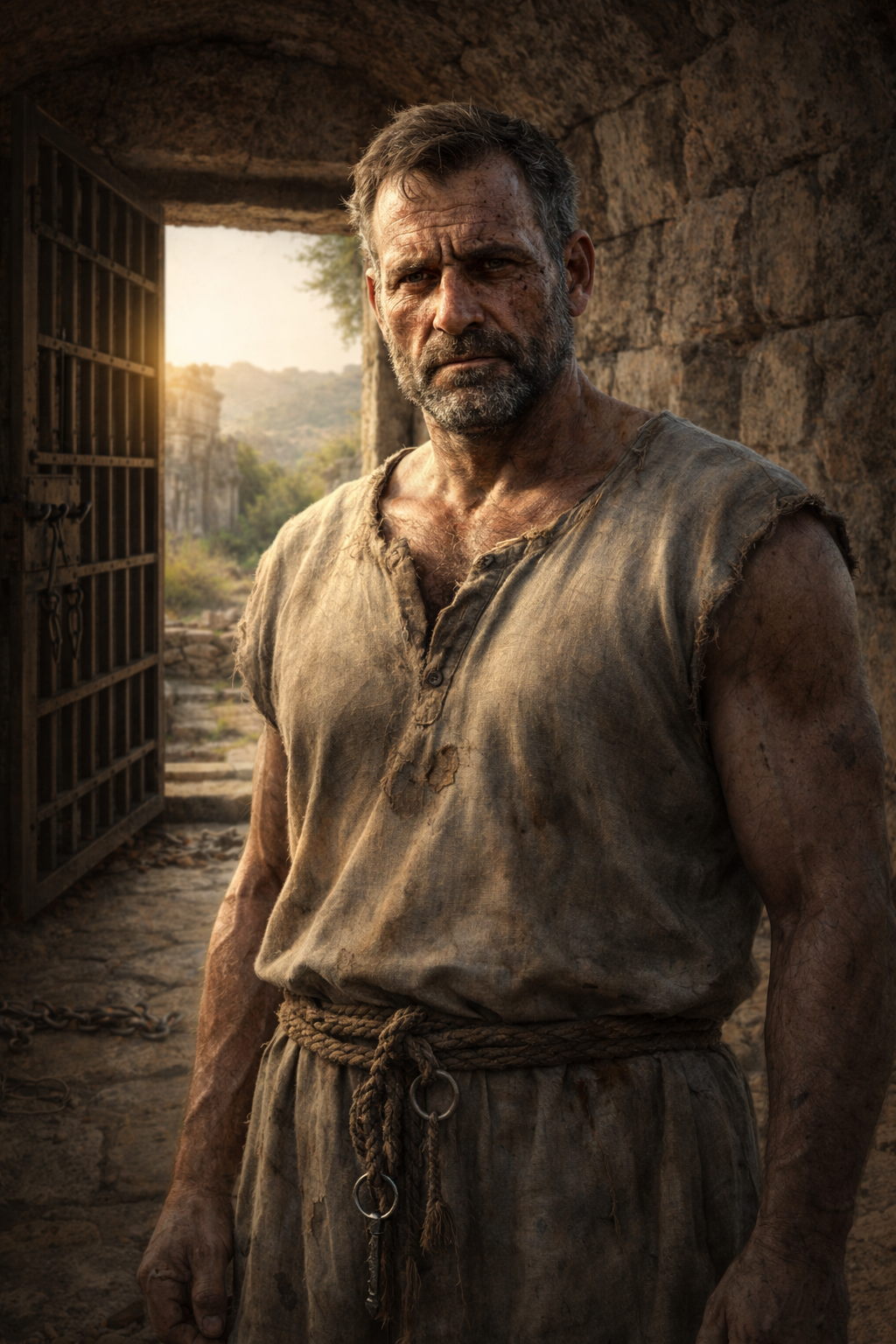
An imagined image of the Philippian jailer in first century Philippi.
The position carried status, but it also carried risk. A single escape could mean disgrace or even death. Rome had an honor-shame framework. A jailer was expected to uphold his charge even at the cost of his own life.
If prisoners fled, the dishonor didn’t end with him. It spilled onto his household. The Roman solution was grim but culturally coherent: suicide. This wasn’t cowardice. It was preservation of dignity. A way to shield one’s family from public shame and possible financial ruin.
When the earthquake struck and the doors flew open, the jailer didn’t pause to deliberate. His training had already given him his answer.
But the night does not unfold as expected.
From inside the prison comes a calm, steady, and utterly unexpected voice:
“Do yourself no harm, for we are all here.”
It is Paul the Apostle, speaking into chaos. The doors are open; the chains are loosened, but the prisoners have not fled.
And this is far more upsetting than an empty cell. His carefully ordered world is suddenly interrupted by God’s grace, God’s mercy.
For most of Philippi, the quake would’ve meant panic and a rush to the temples to appease the gods.
For the jailer, it becomes a turning point. When the ground gives way beneath his feet, something deeper fractures—certainty.
In that moment, he is forced to face a truth he’d never considered. The empire he served so faithfully is not the final authority over his life.
Paul’s steady words—spoken into the rubble—become the biggest aftershock in the jailer’s heart.
Soon after, he will wash wounds, open his home, and choose baptism for himself and his household. A man once defined by containment becomes a man of hospitality.
The believers in Philippi understood something we often forget. Not all earthquakes register on seismographs. Some shake cities. Others shake allegiances.
The jailer’s transformation belongs to the second kind.
The quake brings him face to face with mortality, misplaced security, and a new kind of authority. His old loyalties to Rome, to stability, and to self-preservation begin to loosen.
For the early Christians, the most powerful upheavals were not geological. They were spiritual. Most of us do not welcome shaking.
We pray for steadiness, for clarity, for walls that remain intact.
But the jailer’s story reminds us that not every rupture is ruin. Sometimes the trembling reveals a door we didn’t know was there. The question is never whether the ground will move. It will.
When it does, what will we cling to, and what might we be invited to release?
Some earthquakes shake stones.
Others gently loosen the allegiances of the heart.
