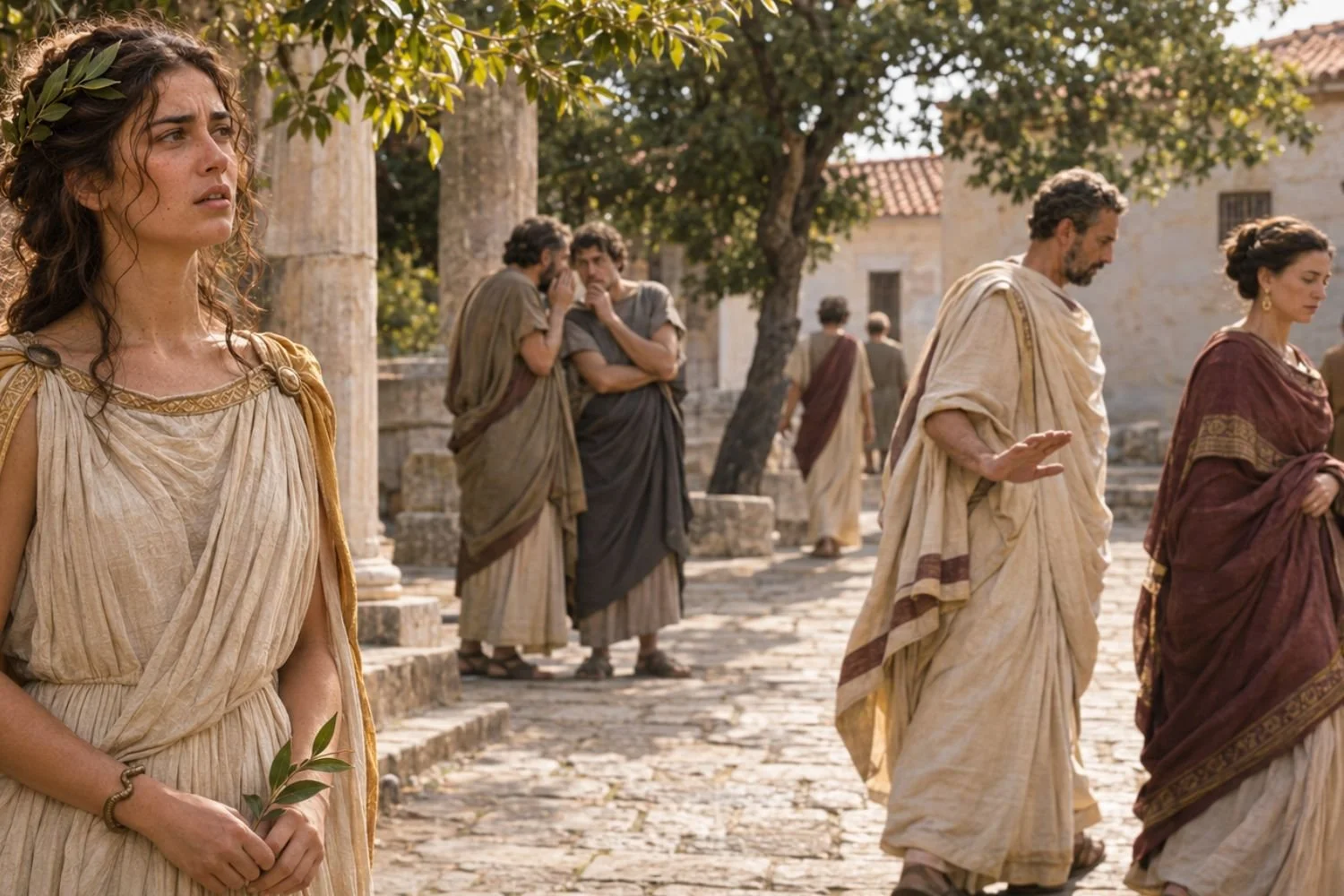
Why Philippi Distrusted Mynestra
Sometimes stepping into the light means leaving the old circle behind.
In Oracle of Philippi, Mynestra’s reputation has been built over years of serving as a prophetic voice associated with Apollo. She has a place within Philippi’s religious and social world. People recognize her. Wealthy patrons seek her words. Her owners profit from them.
But when she turns toward the Christian faith, she begins to lose the protections and honors that world had given her.
The old world could be warm when she was useful to it. It could also be cold when she was not.
Losing the World That Defined Her
For years, Mynestra’s voice has been her livelihood. Her relationship with Kaius and Fulvia, her reputation in the city, and her access to people far above her station all depend upon her role as an oracle.
The advantages are real.
Her prophetic reputation gives her a status few enslaved women could possess. Wealthy people seek her counsel. Her words can influence personal decisions, business arrangements, and public plans.
But none of that influence belongs entirely to her. It depends upon her continuing to fulfill the role others have assigned to her.
When Paul commands the spirit to leave her in Acts 16, the unnamed slave girl can no longer earn money for her owners. Luke tells us what they do next: they seize Paul and Silas and drag them before the authorities.
He doesn’t tell us what happens to the girl.
In my novel, I imagine that moment as the beginning of Mynestra’s freedom—but not the end of her losses.
When she turns away from Apollo and begins to follow Christ, she doesn’t merely exchange one set of religious beliefs for another. She loses the identity, relationships, and limited protection that have shaped her life.
Rejection in Philippi
Some people pity Mynestra, believing she has become confused or damaged. Others avoid her, afraid that rejecting Apollo might bring divine displeasure. Still others see her as ungrateful—a woman who received attention and privilege through the god’s favor and then turned against him.
Her rejection is seldom dramatic.
A merchant who once greeted her warmly busies himself with another customer.
A door that once opened to her closes with a polite excuse.
An acquaintance sees her in the marketplace and looks away.
These are small losses, but together they tell her that the world she once inhabited has withdrawn its welcome.
For a woman without legal freedom, strong family connections, or independent wealth, that withdrawal carries more than emotional pain. Patronage and personal relationships provide practical protection in Roman society. When those relationships disappear, vulnerability follows.
What Religious Conversion Could Cost
Religion in the Roman world wasn’t confined to private belief. Worship helped bind households and cities together. Sacrifices honored the gods believed to protect the community. Festivals reinforced civic identity. Participation demonstrated loyalty—to one’s family, one’s city, and Rome itself.
Turning away from a god could therefore be interpreted as more than a personal decision.
It might be seen as betrayal: rejecting the community that honored the god.
It might be seen as ingratitude: refusing to repay divine favor with continued loyalty.
It might even be regarded as dangerous. If the gods protected the city, refusing to honor them could appear to place everyone at risk.
The degree of rejection an early Christian experienced would have depended upon personal circumstances. Acts does not describe a single response shared by every household or city. But the New Testament repeatedly shows that allegiance to Christ could strain family ties, disrupt livelihoods, and expose believers to public suspicion.
For Mynestra, the implications are especially sharp. In the story, she has not merely worshipped Apollo. She has been publicly identified with his prophetic power.
Her departure raises an uncomfortable question for everyone who once trusted her:
If she now rejects Apollo, what does that say about the voice they believed they heard through her?
The Novel’s Perspective
Mynestra’s courage is not expressed through a dramatic denunciation of her old life. It appears in her willingness to keep walking through a city that no longer knows where to place her.
She enters spaces where she is no longer welcomed.
She encounters people who remember what she was but cannot imagine what she is becoming.
She continues to follow Christ even when doing so has not yet brought her security, acceptance, or a clear place within the Christian community.
The pagans distrust her because she has abandoned Apollo.
Some Christians remain cautious because they remember her former prophetic voice.
She stands between two worlds—released by one but not yet fully received by the other.
When Freedom Feels Like Loss
We often imagine freedom as the immediate removal of pain. The chains fall away, the door opens, and a new life begins.
But freedom can also uncover how much the old captivity provided.
A role may have restricted us while also giving us an identity. A community may have controlled us while still offering companionship. A position may have required silence or performance while providing security.
Leaving such a world can be both liberating and painful.
For some people, the break is unmistakable: separation from a family, religious community, profession, or way of life. For others, it happens quietly. Friendships fade. Invitations stop. Familiar places no longer feel like home.
The loss is real. Acknowledging it does not mean the decision to leave was wrong.
Mynestra must learn that she is no longer valuable because of what others can obtain from her voice. She is welcomed into a community intended to be rooted not in usefulness, status, or patronage, but in grace.
Yet even that welcome takes time to become something she can trust.
Sometimes the old world does not release us gently.
Sometimes it simply closes behind us.
The life ahead may still be uncertain. But for the first time, it is a life in which becoming someone new is possible.
***
Acts never tells us the enslaved girl’s name or what happened after the spirit left her. A Cage of Gold imagines the path that brought Mynestra into bondage. Oracle of Philippi imagines what freedom might have required of her afterward.
Begin with A Cage of Gold
Continue with Oracle of Philippi
