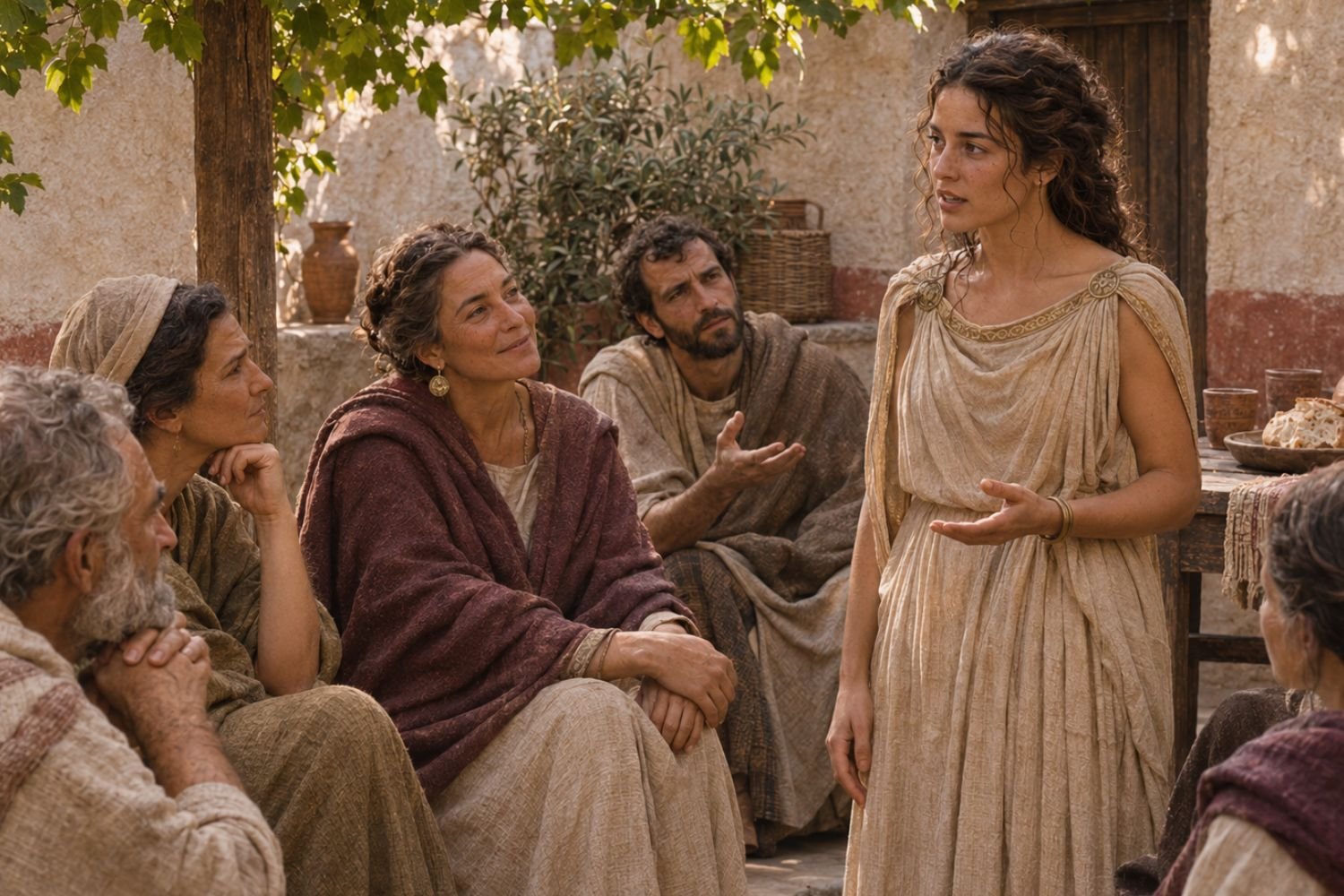
A woman rises to speak in a gathering of believers.
Some recognize her. They remember the words she once delivered in Apollo’s name. They remember the people who sought her guidance and the owners who profited from her voice.
Now she claims to speak by the Spirit of God.
Should they listen?
This particular scene belongs to my novel, Oracle of Philippi. Acts 16 does not tell us that the fortune-telling slave girl became a Christian or later prophesied among the believers. But the question behind the scene is historical: How did the early church decide whether a prophetic message came from God?
The answer was not simply, “If it sounds spiritual, accept it.”
Early Christians welcomed prophecy, but they were also commanded to test it.
Prophecy Was More Than Predicting the Future
We often think of prophecy as predicting something that has not yet happened. Biblical prophecy could include warnings or revelations about the future, but its purpose was broader than that.
Paul told the Christians in Corinth that “the one who prophesies speaks to people for their strengthening, encouraging and comfort” (1 Corinthians 14:3).
Prophecy could warn, reveal, encourage, correct, or help a congregation understand how God was at work among them. It was a spiritual gift intended to strengthen the church—not to elevate the person speaking.
A prophet wasn’t supposed to become a performer whose authority couldn’t be questioned. The message belonged to the gathered community, where it could be heard and weighed.
Israel Had Always Tested Its Prophets
The early Christians inherited their understanding of prophecy from Israel’s Scriptures.
Deuteronomy offered more than one test.
The first concerned whether a prediction proved true. If someone spoke presumptuously in God’s name and the predicted event didn’t occur, the message hadn’t come from God (Deuteronomy 18:20–22).
But accuracy alone wasn’t enough.
Deuteronomy 13 warned that even if a prophet announced a sign that came to pass, the people must not follow that prophet if the message led them away from the Lord.
A remarkable sign didn’t automatically authenticate the person who produced it. Neither did confidence, eloquence, or apparent spiritual power.
The message also had to be faithful to God.
Israel’s long history included prophets who confronted kings, warned the people, and called them back to covenant faithfulness. It also included false prophets who offered reassurance when judgment was approaching or claimed divine authority for their own words.
The early church did not begin with the assumption that every spiritual-sounding message should be believed. It inherited a tradition of careful discernment.
“Test Everything”
Paul gave the church in Thessalonica two instructions that had to be held together:
“Do not quench the Spirit. Do not treat prophecies with contempt but test them all; hold on to what is good” (1 Thessalonians 5:19–21).
The Thessalonians were not to silence prophecy merely because it might be misused. But neither were they to accept every message without examination.
They were to listen—and test.
Paul gave more specific instructions to the church in Corinth. When believers gathered, two or three prophets could speak, and “the others should weigh carefully what is said” (1 Corinthians 14:29).
Discernment was therefore communal. A prophetic message was not beyond examination simply because someone introduced it with the words, “The Lord told me.”
Other believers listened. They weighed the message. They considered whether it agreed with the gospel they had received and whether it strengthened the church.
No single voice was intended to overpower the gathering.
Spiritual Speech Was Not Uncontrollable
The manner in which a message was delivered also mattered.
In the surrounding Greco-Roman world, people encountered many forms of religious speech. They consulted oracles, interpreted dreams, watched for omens, and sought messages from the gods. Some forms of inspired speech were associated with an altered or ecstatic state.
Paul did not present loss of control as proof that God was speaking.
“The spirits of prophets are subject to the control of prophets,” he told the Corinthians, “for God is not a God of disorder but of peace” (1 Corinthians 14:32–33).
A Christian prophet could wait while another person spoke. The prophet could remain silent when necessary. The community’s gathering was to proceed in an orderly way so that everyone might learn and be encouraged.
Intensity did not prove divine inspiration. Neither did emotional force.
The Spirit’s presence did not erase a speaker’s responsibility.
The Source of the Message Mattered
This helps explain a troubling moment in Acts 16.
As Paul and his companions traveled through Philippi, an enslaved girl with “a spirit of Python” followed them, crying:
“These men are servants of the Most High God, who are telling you the way to be saved” (Acts 16:17).
Her words appear to be true. Why, then, did Paul command the spirit to leave her?
To a modern Christian reader, “the Most High God” clearly points to the God of Israel. In Philippi, however, the words could have been heard through a Greco-Roman religious framework. A pagan listener might have associated the highest god with Zeus—or understood “salvation” according to one of several religious traditions.
The declaration could make Paul’s message sound like one more form of spiritual power within the religious world of Philippi.
Paul would not allow the gospel to be authenticated by the spirit speaking through the girl. The source of a proclamation mattered as much as its surface meaning.
The passage also reminds us that correct words are not, by themselves, enough to establish spiritual authority.
Character Mattered Too
A later Christian document known as the Didache, probably compiled near the end of the first century or in the early second, shows how concerns about false prophets continued after the period of Paul’s earliest churches.
Traveling teachers and prophets moved among Christian communities. Hospitality was expected, but exploitation was a genuine danger.
The Didache warned that a visitor who remained too long without contributing to the community might be taking advantage of his hosts. A supposed prophet who asked for money for himself was not to be trusted. Most significantly, it said that a prophet who taught the truth but failed to practice it was a false prophet.
By this period, conduct had become one of the clearest tests of a person’s claims.
Did the prophet live according to the teaching he gave others?
Was the person serving the community or using spiritual authority to gain money, comfort, or influence?
The church did not look only at the prophet’s words. It watched the prophet’s life.
What Did the Church Consider?
The New Testament does not give us a single checklist used identically by every congregation. Taken together, however, these passages show several questions early Christians could ask:
Does this message lead people toward the God revealed in Scripture, or away from him?
Does it agree with the gospel the church has received?
Does it honor Jesus as Lord?
Does it strengthen, encourage, or correct the community?
Can it be weighed by other believers, or does the speaker demand unquestioned authority?
Is it delivered with appropriate order and self-control?
Does the speaker’s conduct support the message?
Is the person serving others or seeking status, money, or control?
Testing prophecy was not necessarily an accusation against the person speaking. It was part of the church’s responsibility.
Even sincere people could misunderstand an impression, interpret it incorrectly, or allow personal desires to shape what they believed they had heard.
Discernment protected both the congregation and the speaker.
The Problem Mynestra Would’ve Faced
In Oracle of Philippi, I imagine that the unnamed slave girl of Acts 16 survives Paul and Silas’s imprisonment and eventually becomes part of the Christian community. I call her Mynestra.
That part of her story is fiction. But the tension created by her past is grounded in the world of the early church.
For years, Mynestra had been known as a prophetic voice associated with Apollo. Her owners had profited from her words. People throughout Philippi would have recognized her and remembered what she had been.
If she later spoke of a dream, vision, or message among the Christians, they could not be expected to forget that history immediately.
Some might wonder whether her understanding of prophecy was still shaped by the temple.
Others might question the source of her words. A few might be afraid of what had once spoken through her.
Their caution wouldn’t necessarily mean they believed Christ had failed to free her. It would mean that trust, especially in matters of spiritual authority, required time and discernment.
Her words needed to be weighed just as anyone else’s were.
For Mynestra, however, that necessary caution would still hurt. She had left a world in which her voice was accepted because of the role assigned to her. Now she had entered a community that cared enough about truth to examine what she said.
She would have to learn that being questioned was not the same as being rejected.
And the believers would have to learn that a person’s past should invite wisdom without becoming a permanent sentence.
Listening Without Being Deceived
The early church faced two dangers.
It could become so suspicious that it silenced every prophetic voice and quenched the work of the Spirit. Or it could become so eager for divine revelation that it believed every person who claimed to speak for God.
Paul permitted neither response.
“Do not treat prophecies with contempt,” he wrote. But also: “Test them all.”
Discernment stood between unquestioning acceptance and fearful rejection. The church listened, examined, and held on to what was good.
The question was never simply whether someone spoke with conviction.
The deeper questions were these:
Where does this message lead us?
What does it produce among us?
And can it withstand the careful judgment of the community?
***
Acts never tells us the enslaved girl’s name or what happened after the spirit left her. A Cage of Gold imagines the path that brought Mynestra into bondage. Oracle of Philippi imagines what freedom might have required of her afterward.
Begin with A Cage of Gold
Continue with Oracle of Philippi
