What did Delphi have to do with the unnamed diviner in Philippi?
When I began a close reading of Acts 16, the unnamed enslaved girl captured my attention…
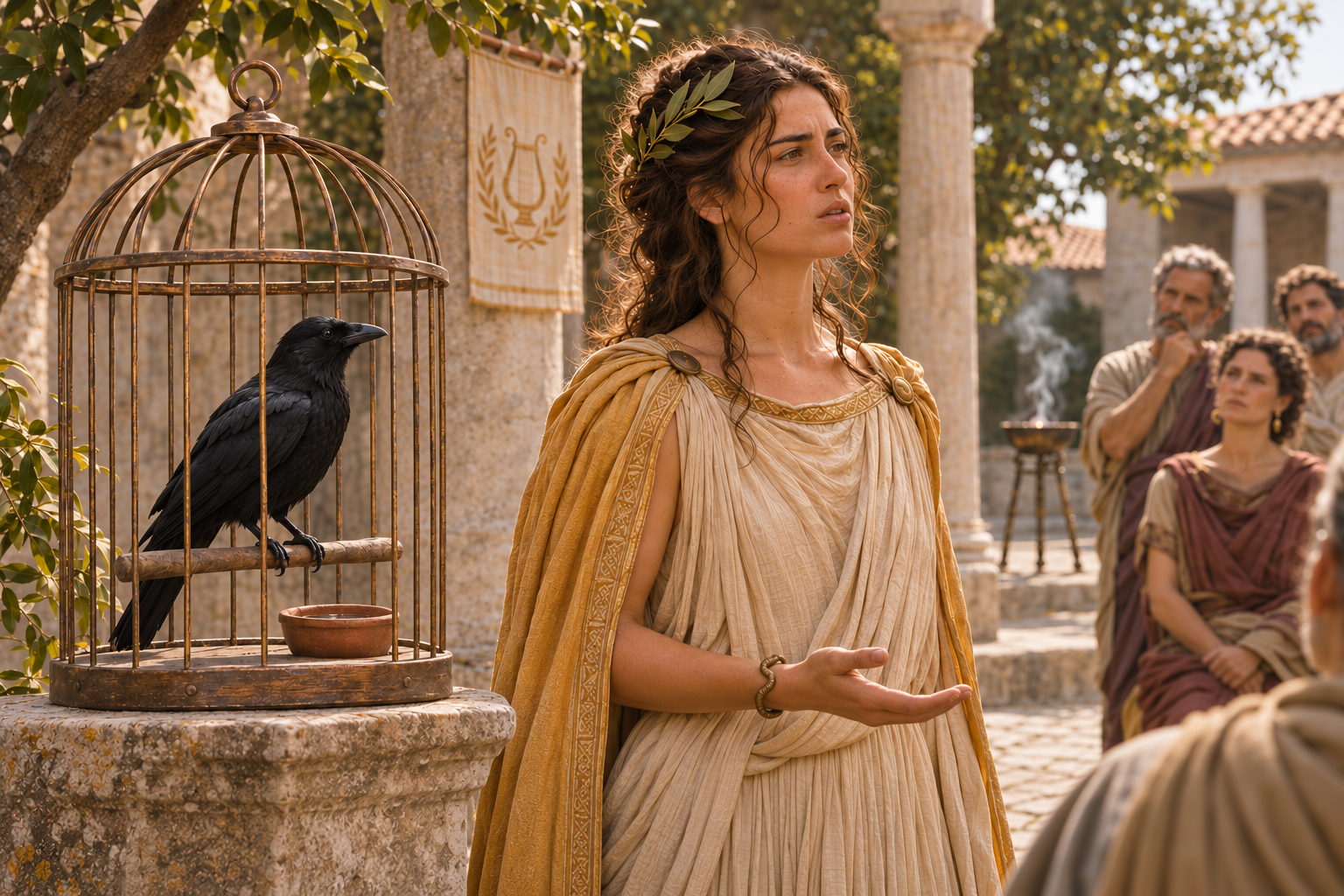
Luke tells us very little about her. She follows Paul and his companions through Philippi, proclaiming they are the servants of the Most High God. After several days, Paul commands a spirit to leave her. It does, and her owners become furious because their source of income is gone.
After that, she disappears from the account.
I wanted to know more.
I began reading about divination in the ancient world, Greek oracles, Apollo’s sanctuary at Delphi, slavery in Roman society, and the religious world of first-century Philippi. I also read more than a dozen commentaries on Acts.
During that research, I noticed how easily a familiar English expression could obscure an unfamiliar ancient world. The girl is often called a fortune-teller—a phrase that might bring to mind palm reading or a modern carnival booth.
But Luke uses a more culturally specific expression.
He says she had “a spirit of Python.”
The Name Beneath the Translation
Acts 16:16 describes her as having a pneuma pythōna—literally, a “spirit of Python.” Many English Bibles render this “a spirit of divination,” communicating what the spirit enabled her to do.
That translation is understandable, but the name deserves attention.
For readers familiar with Greek religious traditions, Python could evoke Delphi, Apollo, and the Pythia, the woman through whom Apollo was believed to speak.
In Greek mythology, Apollo killed a serpent or dragon associated with Delphi. In the familiar tradition, that creature was Python. Its name remained embedded in the sanctuary’s identity. Apollo was called Pythian Apollo, and his priestess was the Pythia.
For centuries, individuals and representatives of cities traveled to Delphi seeking guidance. Questions concerned war, colonization, religious obligations, civic crises, and private decisions.
The Pythia served within a larger sanctuary community. Priests and attendants helped oversee its activities, and consultation involved religious preparations and offerings. The precise manner in which responses were delivered and presented remains debated and may have changed over Delphi’s long history.
What gave the oracle its authority was the belief that Apollo spoke through her.
Was the Girl in Acts a Priestess of Apollo?
Luke’s language has a connection with that religious world, but it does not establish that the girl served Apollo in a temple.
By the first century, Python terminology could be used more broadly for people credited with supernatural divining speech. It did not necessarily indicate training at Delphi, membership in its priesthood, or participation in an institution organized like the Delphic sanctuary.
Acts does not call the girl the Pythia. It does not identify her as a priestess or describe a shrine where she worked. The expression alone cannot tell us how she understood her ability or which deity her clients associated with it.
That distinction mattered as I researched my novel. Delphi helped me understand the cultural associations surrounding Luke’s words. It could not provide a biography for the unnamed girl in Philippi.
A Voice That Brought Other People Money
Luke gives us three firm details about her circumstances: she was enslaved; she practiced divination through what he calls a spirit of Python, and her activity brought her owners considerable income.
People paid for her divination. Her owners profited.
Whatever recognition her ability brought her, it existed within an arrangement in which other people controlled her labor and received its earnings. Religious significance and economic exploitation could occupy the same life.
Acts does not tell us how that life began. We do not know whether she was born into slavery or enslaved later, whether her owners had trained her, or whether she ordinarily received clients in a house, a public place, or some other setting.
We encounter her walking behind Paul and his companions, calling out about them.
Even there, we hear almost nothing about what she wanted.
When the Profit Disappeared
Luke links the departure of the spirit with the departure of the owners’ hope of profit. The repetition is especially striking in Greek: something has gone out of the girl, and something has gone out of their business.
They respond by seizing Paul and Silas and dragging them before the authorities.
Yet their public accusation does not concern lost earnings. They identify the missionaries as Jews and accuse them of disturbing the city and advocating customs that Romans should not accept.
A private financial grievance becomes a public appeal to ethnic difference and Roman civic identity.
The girl’s welfare doesn’t enter their argument.
Nor does the departure of the spirit necessarily change her legal position. Acts describes release from the spirit. It does not describe release from slavery.
Her owners’ loss of income might’ve altered her circumstances profoundly, but we are not told how they treated her afterward.
That silence troubled me.
What happened when someone who’d been valuable for a particular ability could no longer provide it? Where could she go? Who would take responsibility for her well-being?
From the Unnamed Girl to Mynestra
In Oracle of Philippi, I give her a name: Mynestra.
I imagine a young woman whose public identity has been carefully shaped by her owners. Her clothing, serpent jewelry, ritual appearances, and association with Apollo help sustain the belief that she possesses an extraordinary prophetic voice.
Those details belong to the novel. They are possibilities I developed, not information supplied by Acts.
Her owners, Kaius and Fulvia, cultivate her reputation because it brings them money and influence. What others perceive as religious distinction remains, for Mynestra, a life in which she has little authority over herself.
Then Paul arrives.
When the spirit leaves her, the role her life has been organized around begins to collapse. But deliverance does not immediately give her legal freedom, a secure home, or a community willing to trust her.
She must live beyond the moment that changed everything.
As I wrote, another question emerged: How might she have entered this life in the first place?
That question became A Cage of Gold, the prequel to Oracle of Philippi. It imagines the circumstances through which a vulnerable young woman might be drawn into a world where religious authority, patronage, commerce, and slavery reinforce one another.
Neither story supplies a missing chapter of biblical history. Both explore possibilities surrounding a person whose life the biblical account leaves largely unknown.
The Person Beyond the Label
Acts doesn’t tell us the girl’s name, her origins, or what became of her. It doesn’t say that she became a Christian or joined the believers in Philippi.
Those omissions are boundaries for historical claims. For a novelist, they also raise human questions.
What might she remember? Whom might she fear? How would she understand herself after the ability that had defined her was gone?
It’s easy to remember people in Scripture chiefly through their defining circumstances—blind, ill, enslaved. Those descriptions are important, but they are not all of what a person is.
The girl in Acts had a life before she encountered Paul. Presumably, she continued living after the narrative turned its attention elsewhere.
Research helped me understand something of the world around her. Fiction allowed me to ask what it might’ve felt like to inhabit that world, and then to find its familiar meanings coming apart.
For Mynestra, learning to speak becomes part of learning that she is a person whose words, fears, and hopes matter even when they produce no income.
Luke gives the unnamed girl only a few verses.
I kept wondering about the life beyond them.
Sources and Further Reading
Acts 16:16–24
Homeric Hymn to Apollo, for an early version of Apollo’s encounter with the serpent at Delphi
Plutarch, The Oracles at Delphi and The Obsolescence of Oracles, for ancient discussions of Delphic prophecy
***
Acts never tells us the enslaved girl’s name or what happened after the spirit left her. A Cage of Gold imagines the path that brought Mynestra into bondage. Oracle of Philippi imagines what freedom might have required of her afterward.
Begin with A Cage of Gold
Continue with Oracle of Philippi
