If you’ve read Oracle of Philippi, you know that Mynestra has a tame crow named Sylvanus.
When I first began writing the novel, I imagined giving her a raven. But ravens are large birds—too large for the gilded cage I had pictured. As I researched crows, however, I discovered that one might be an even better companion for a young woman associated with Apollo and prophecy.
Imagine walking toward a shrine in first-century Greece. A black bird lands on a nearby column and gives a sharp cry.
You might notice where it landed. You might listen for another call. If you were already seeking guidance from a god, you might wonder whether its appearance meant something.
In the ancient world, a crow wasn’t always a mere bird.
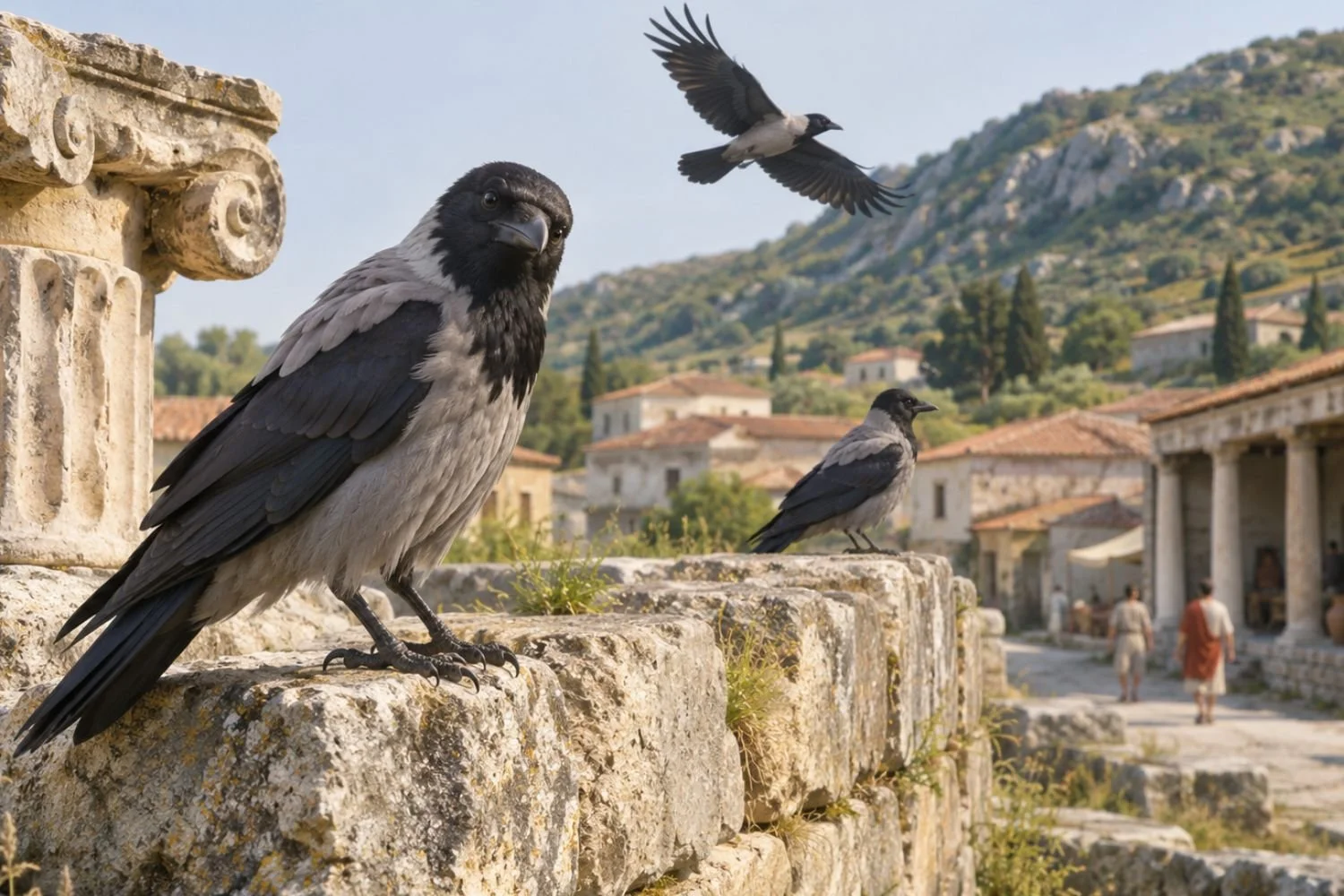
Hooded Crow
Apollo’s Black Bird
One of the best-known stories connecting Apollo with a black bird concerns Coronis, a woman he loved.
According to the version told by the Roman poet Ovid, Apollo’s bird was originally white. It discovered that Coronis had been unfaithful and carried the unwelcome news to the god. In his anger, Apollo changed the bird’s feathers from white to black.
Most English translations of the story call the bird a raven. Ancient Greek and Latin writers did distinguish between crows and ravens in some contexts, but the words haven’t always been translated consistently in later retellings. Both birds belonged to the larger family of clever, black-feathered corvids, and both developed associations with omens and divine communication.
The important point for an ancient listener was the bird’s connection with Apollo. It had seen something hidden and carried the truth to the god.
That made the story especially appropriate for a god associated with prophecy.
Listening to Birds
Greeks had a long tradition of interpreting the behavior of birds. Flight, cries, direction, and timing could all be treated as signs. A person skilled in interpreting them might be consulted before a journey, battle, or other important undertaking.
The Romans developed their own formal system for seeking the gods’ approval, known as taking the auspices. An augur marked out a sacred area of observation and watched or listened for particular signs.
Not every bird communicated in the same way. Eagles and vultures were often interpreted by their flight. Crows and ravens belonged among the birds whose calls carried significance. Which side the call came from could affect its meaning—and the rules were more complicated than simply declaring every crow fortunate or ominous.
The bird did not necessarily predict a detailed future. Rather, its behavior might indicate whether the gods favored an intended action.
Should an official proceed? Should an army advance? Was this the proper time to act?
In Rome, such questions weren’t merely private superstition. Auspices formed part of public religion and could affect civic and military decisions.
What Did a Crow Mean?
A crow’s meaning depended upon the circumstances. Where had it appeared? From which direction had it called? What was someone preparing to do at that moment?
An isolated cry might be interpreted differently from repeated calling. A bird appearing during a religious ceremony might attract more attention than one scavenging beside the road.
Crows and ravens also invited interpretation because they appeared observant. They watched human activity, recognized opportunities, and responded to changes around them. Their intelligence could make them seem as though they knew more than an ordinary bird should.
Ancient writers sometimes treated their behavior as evidence of unusual perception. Pliny the Elder included stories about ravens learning human speech and recognizing individual people. He also discussed crows and ravens as birds associated with signs and forewarnings.
Some of his stories sound exaggerated to modern readers. Yet they reveal something important about how Romans regarded these birds: their intelligence was already part of their reputation.
A Crow for Mynestra
Knowing these associations, I decided that Mynestra’s companion should be a crow.
Sylvanus is smaller than the raven I first imagined, but he carries many of the same associations. He is black-feathered, intelligent, watchful, and linked in the ancient imagination with omens.
His presence beside Mynestra contributed to the image her owners created around her. Visitors seeking Apollo’s guidance might see the tame bird and assume that it confirmed her connection with the god.
Perhaps they would say Apollo’s own bird had chosen her.
That belief would strengthen Mynestra’s reputation and make her more profitable to the people who controlled her.
The bird would not have to possess supernatural knowledge. What mattered was how people interpreted him. In Philippi, reputation could be shaped by appearance, ritual, and expectation long before anyone stopped to ask what was true.
Seeing the World Through Ancient Eyes
We sometimes imagine the ancient world as our own world with different buildings and clothing. But the people who inhabited it often interpreted nature through different assumptions.
A sudden storm might communicate divine displeasure. An earthquake might warn that something had gone wrong in the relationship between a city and its gods. An unusual animal might be treated as a prodigy demanding investigation.
And a crow might be an omen, a messenger, or a reminder that the gods were watching.
Not everyone responded identically, and ancient people could also be skeptical about divination. Cicero, writing in the first century BCE, preserved arguments both for and against it. But the formal importance of auspices and the repeated appearance of bird signs in ancient literature show that such interpretations were part of the cultural world.
This is the world Mynestra inhabits.
To a modern reader, Sylvanus may be an intelligent and occasionally troublesome pet. To the people who encounter him in Oracle of Philippi, he may represent something more.
They see a black bird beside a woman known for prophecy and draw their own conclusions.
***
Meet Sylvanus
History explains why a crow would carry meaning in Mynestra’s world. But Sylvanus is more than a religious symbol. In Oracle of Philippi, he becomes her companion, and reveals something about the life she longs to possess for herself.
Read The Watcher of the Ancient World—Fiction Edition (This has an excerpt of a scene from Oracle of Philippi.
Explore more of the history, culture, and beliefs behind Scripture and biblical fiction. World Behind the Story
