The trouble in Philippi begins when an enslaved woman loses her ability to make money for her owners.
The trouble in Ephesus begins when a silversmith fears that Paul’s preaching will diminish the market for silver shrines.
In both cities, the Christian message touches more than private belief. It threatens an established source of income.
Private alarm becomes public accusation. Other people are drawn into the dispute. Soon, the streets fill with anger.
Acts 16 and Acts 19 unfold in different cities, under different circumstances. But read together, they reveal how quickly threatened profit can be defended in the language of religion, civic identity, and public order.
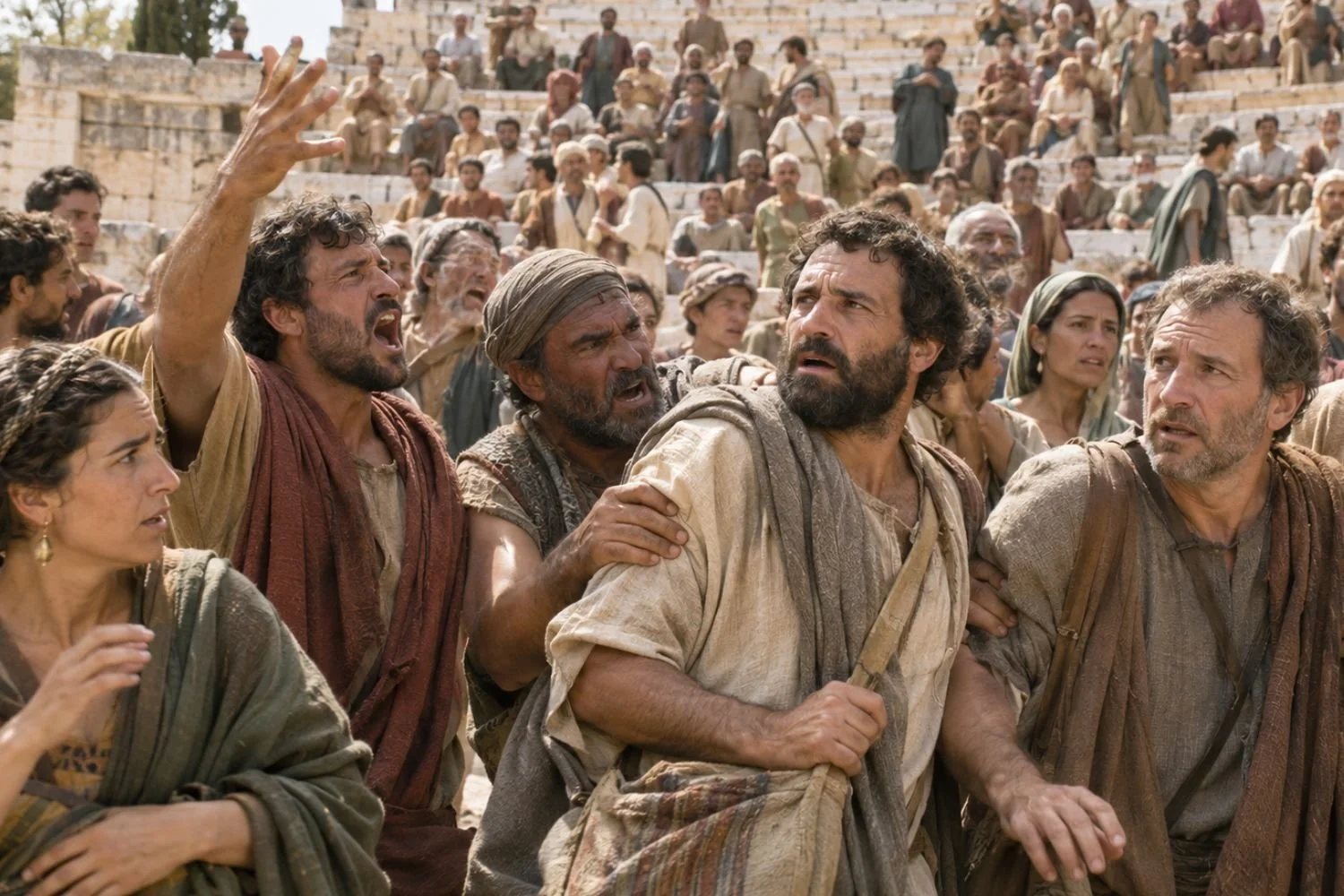
Philippi: When the Profit Disappears
In Philippi, Paul and his companions encounter an enslaved girl with what Luke calls “a spirit of Python.” She follows them for several days, proclaiming:
“These men are servants of the Most High God, who are telling you the way to be saved.”
—Acts 16:17
Paul eventually turns and commands the spirit to leave her in the name of Jesus Christ. It leaves, an Luke then shifts our attention to the girl’s owners:
“When her owners realized that their hope of making money was gone, they seized Paul and Silas and dragged them into the marketplace to face the authorities.”
—Acts 16:19
The girl has lost her ability to practice divination. Her owners have lost the income they received from it. Their concern isn’t what will now happen to her. They’re concerned about what’s happened to their revenue.
The Business Behind the Prophecy
Religion and commerce were not separate parts of ancient urban life.
People paid for sacrifices, votive objects, consultations, festival goods, and services associated with temples and shrines. Artisans produced religious images. Merchants supplied animals, incense, oil, wine, cloth, and other materials used in worship.
The enslaved diviner in Philippi participated in this wider religious economy, although Acts doesn’t tell us where or how she received clients. We know only that her ability to predict or disclose information brought her owners considerable profit.
As long as she produced valuable words, they had reason to maintain her public role. Once the spirit left, they didn’t see the event not as liberation, but as financial damage.
Yet money isn’t the charge they bring before the magistrates.
Turning Financial Loss into a Civic Accusation
The owners drag Paul and Silas into the marketplace and accuse them before Philippi’s magistrates:
“These men are Jews, and are throwing our city into an uproar by advocating customs unlawful for us Romans to accept or practice.”
—Acts 16:20–21
The accusation changes shape as soon as it enters the public forum. They don’t say, “These men have deprived us of income.”
They say Paul and Silas are disturbing the city, identifying them as Jews and contrasting them with “us Romans.” They suggest that the strangers threaten the customs and identity of the colony.
The financial grievance may not have inspired widespread sympathy, but a supposed attack upon Roman order does.
The crowd joins the protest. The magistrates order Paul and Silas stripped, beaten, and imprisoned.
An economic loss affecting a few owners has become a civic disturbance involving the entire forum.
Ephesus: When an Industry Feels Threatened
Several chapters later, Acts describes another disturbance.
Paul has spent an extended period in Ephesus, one of the most important cities in the Roman province of Asia. His teaching has spread beyond the city into the surrounding region.
Ephesus was famous for the worship of Artemis. Her enormous temple was counted among the wonders of the ancient world and drew visitors from across the Mediterranean. The sanctuary’s importance was religious, civic, and economic.
A silversmith named Demetrius makes small silver shrines of Artemis. Acts says that his work generates substantial business for other craftsmen.
Unlike the owners in Philippi, Demetrius hasn’t necessarily lost his entire income, but he does see that possibility approaching.
He gathers the craftsmen and workers in related trades and tells them:
“You know, my friends, that we receive a good income from this business.”
—Acts 19:25
As in Acts 16, he begins with money. And, as in Acts 16, he doesn’t end there.
“Gods Made by Human Hands Are No Gods”
Demetrius tells the craftsmen that Paul has persuaded many people that “gods made by human hands are no gods at all.”
If people accept Paul’s message, they will no longer view silver shrines as sacred objects worthy of purchase.
Demetrius recognizes the economic consequences:
“There is danger not only that our trade will lose its good name, but also that the temple of the great goddess Artemis will be discredited.”
—Acts 19:27
His argument joins three interests: The prosperity of the craftsmen; The reputation of their trade; The honor of Artemis and her temple
These concerns may all have been genuine. It would be too simple to assume that Demetrius cared only about money and felt no devotion to Artemis. In Ephesus, occupation, religion, and civic identity reinforced one another.
The craftsmen’s income depended upon the goddess’s honor.
The goddess’s public honor was displayed through the goods they produced.
An attack upon one could feel like an attack upon all.
From Trade Meeting to Riot
Demetrius speaks first to people whose livelihoods are connected to his own. They understand the danger immediately.
The craftsmen become furious and begin shouting:
“Great is Artemis of the Ephesians!”
The disturbance spreads into the city. Soon, people rush into the theater, dragging Paul’s traveling companions Gaius and Aristarchus with them.
Paul wants to enter the theater, but the disciples stop him. Some provincial officials who are friendly toward him also urge him not to expose himself to the crowd.
Luke describes the confusion:
“The assembly was in confusion: Some were shouting one thing, some another. Most of the people did not even know why they were there.”
—Acts 19:32
The original grievance has become almost irrelevant.
Many people in the theater don’t even know about Demetrius, silver shrines, or Paul’s teaching. They do know that the city is in an uproar and that the honor of Artemis appears to be at stake.
Private economic fear has become collective emotion.
There are many similarities between both incidents, as well as some important differences.
Where the Incidents Differ
The official response isn’t the same in both cities.
In Philippi, the magistrates react to the crowd. They order an immediate beating without properly determining the identity or legal status of the accused.
In Ephesus, the city clerk does the opposite.
He quiets the crowd and reassures it that the city’s relationship with Artemis is not in question. Ephesus is known as the guardian of her temple; no spontaneous demonstration is needed to prove it.
He also points out that Gaius and Aristarchus have neither robbed temples nor publicly slandered the goddess. If Demetrius and the craftsmen have a legitimate complaint, the courts are open and the provincial authorities are available.
Then he warns the assembly:
“As it is, we are in danger of being charged with rioting because of what happened today.”
—Acts 19:40
This changes the crowd’s response.
In Philippi, the language of public order is used to punish Paul and Silas.
In Ephesus, the danger of violating public order is used to disperse the crowd.
The Ephesian official does not defend Christian theology. He defends lawful procedure and protects the city from unwanted Roman scrutiny. His intervention prevents the riot from becoming more violent.
Did Christianity Threaten the Ancient Economy?
Christianity didn’t oppose commerce itself.
Lydia, the first person Acts identifies as responding to Paul in Philippi, is a merchant in purple goods. Aquila and Priscilla are tent makers, or leather workers, as is Paul.
The conflict arises when a source of profit depends upon something the gospel directly challenges.
In Philippi, money is made from the compelled speech of an enslaved woman.
In Ephesus, money is made by producing objects associated with a goddess who Paul’s converts will no longer worship.
Acts 19 has already shown some Ephesian believers burning costly books connected with magical practices. That act represents an enormous voluntary economic loss. The new believers decide that the books’ monetary value doesn’t justify preserving the practices they’ve rejected.
Faith changes behavior. Changed behavior changes spending. And changed spending threatens people who depend upon the old behavior continuing.
More Than a Private Belief
Roman authorities usually tolerated a wide range of religious practices as long as those practices did not create disorder or challenge important civic obligations.
Paul’s message, however, didn’t remain confined to private devotion. If handmade gods were not gods, converts would eventually stop buying objects connected with their worship. They might withdraw from rituals, household observances, or trade associations with religious obligations.
A change in allegiance could change an entire way of life.
Demetrius understands this.
Paul has not organized a boycott of Ephesian silversmiths. He hasn’t attacked the Temple of Artemis. The city clerk explicitly notes that Paul’s companions have not robbed temples or blasphemed the goddess.
But the Gospel message has consequences.
If enough people believe it, the market will change.
When Profit Learns the Language of Principle
The owners in Philippi may’ve truly believed the girl’s prophetic ability came from a god. Demetrius and the silversmiths may’ve been devoted worshippers of Artemis as well as craftsmen.
People can defend their income and their beliefs at the same time, not recognizing where devotion ends and self-interest begins.
Acts invites us to notice how the arguments are constructed.
In Philippi, the owners’ lost income disappears from their formal accusation. The case becomes a defense of Roman customs.
In Ephesus, Demetrius openly mentions the craftsmen’s prosperity, then enlarges the danger until the honor of Artemis—and eventually the identity of the entire city—appears to be under attack.
Once the issue has been framed that way, a crowd can be persuaded that another person’s financial loss belongs to everyone.
Private Resentment, Public Unrest
The Christian movement was still small when these events occurred. It had no army, civic office, or economic power with which to compel either city.
Yet it altered individual loyalties.
An enslaved diviner lost the spirit that made money for her owners.
Ephesian converts abandoned practices they could no longer reconcile with their faith.
Those changes were enough to disturb people whose prosperity depended upon the old arrangements remaining unquestioned.
Acts doesn’t say that every encounter between Christian faith and commerce ended in conflict. It does show what could happen when a message of spiritual freedom exposed an economic interest.
In Philippi, the result was a beating and imprisonment.
In Ephesus, it was a theater filled with people shouting the name of their goddess.
In both cities, profit found a larger cause to defend it, and private resentment nearly became public violence.
Sources and further reading
Acts 16:16–24
Acts 19:18–41
UNESCO World Heritage Centre: Ephesus
Biblical Archaeology Society: The Riot at Ephesus and Its Archaeological Setting
***
In my monthly newsletter, I share selected articles from World Behind the Story, reflections, and occasional news about my biblical fiction. You’ll also receive my free Acts 16 guide when you sign up.
Browse all World Behind the Story posts.
Want to experience ancient Philippi through story? Oracle of Philippi follows the enslaved diviner, the Roman lictor who helped punish Paul and Silas, and the people caught between the claims of Rome and the call of a new faith.
