The magistrates of Philippi intended the matter to end quietly.
Paul and Silas had been accused before a crowd, stripped, beaten with rods, and confined in the innermost part of the prison. Their feet had been fastened in stocks. By morning, however, the magistrates were ready to release them.
They sent their lictors to the jailer with a simple order:
“Release those men.”
Perhaps the officials considered one night in prison sufficient punishment. Perhaps they wanted the disturbance ended before another crowd gathered. Perhaps they had learned something about the earthquake that had shaken the prison.
Acts doesn’t tell us.
Whatever their reason, they expected Paul and Silas to accept their freedom and leave without creating further difficulty.
Paul refused.
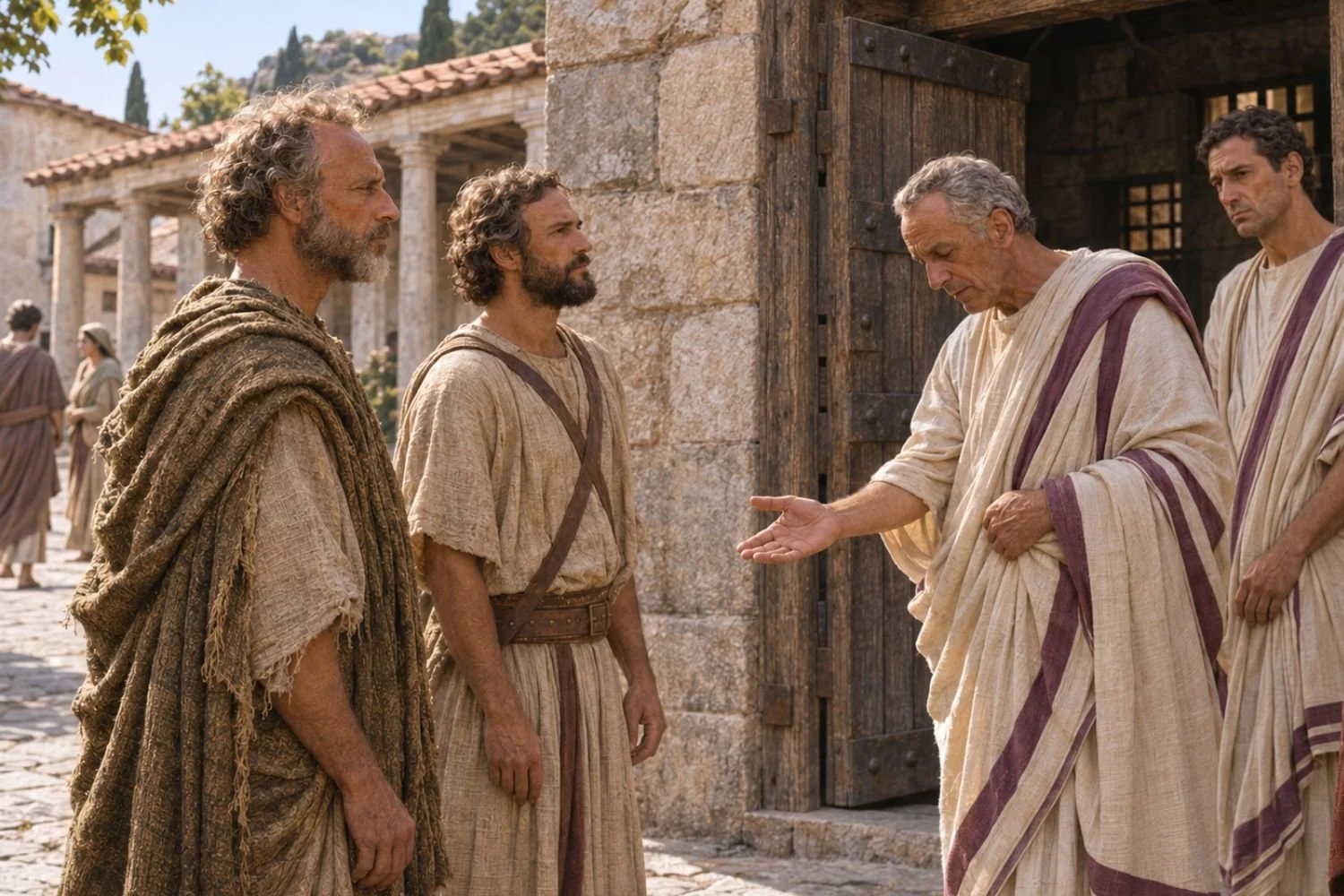
The Magistrates of a Roman Colony
Philippi was proud of its identity as a Roman colony. Its public institutions followed Roman models, Latin was prominent in civic life, and Roman citizenship carried considerable status.
The colony’s two chief magistrates were known formally as duoviri—“two men.” They presided over local government and legal matters. Acts calls them strategoi, a Greek title that could convey their position as chief magistrates.
These men were local officials, probably chosen from among the colony’s elite. They were not distant representatives sent from Rome, but their authority depended upon the Roman legal order they administered.
That made what they had done particularly serious.
They had allowed a crowd to influence their judgment. They had ordered two men publicly stripped and beaten without first determining their legal status. They had imprisoned Roman citizens who had not received a proper hearing.
The officials responsible for upholding Roman order had violated the rights of Romans.
Paul’s Unexpected Refusal
When the jailer reported that the magistrates had ordered their release, Paul answered:
“They have beaten us publicly, uncondemned, men who are Roman citizens, and have thrown us into prison; and now are they going to discharge us in secret? Certainly not! Let them come and take us out themselves.”
—Acts 16:37
Paul’s words emphasize the contrast.
The beating had been public. The release was to be quiet.
The humiliation had taken place before the city. The correction was supposed to happen out of sight.
Paul would not accept that arrangement.
He did not refuse freedom. He refused to let the magistrates erase what they had done by opening a prison door and sending him away.
Why Roman Citizenship Mattered
Roman citizenship carried valuable legal protections. Their precise application could vary according to circumstances, but citizens were not supposed to be subjected to degrading corporal punishment without appropriate legal proceedings.
Publicly beating an uncondemned citizen exposed the magistrates to possible complaint and consequences. At the very least, it demonstrated that they had failed to perform the duties of their office properly.
When the lictors carried Paul’s message back, the sequence in Acts becomes important:
“The police reported these words to the magistrates, and they were afraid when they heard that they were Roman citizens.”
—Acts 16:38
The magistrates did not order Paul and Silas released because they already knew the men were citizens. They learned of their citizenship only after Paul rejected the quiet release.
Then they became afraid.
Acts does not specify exactly what consequences they feared. Paul and Silas might complain to a higher authority. The magistrates’ conduct might damage their position or reputation. A formal inquiry could expose their failure to observe the protections attached to Roman citizenship.
Whatever the precise danger, the officials could no longer treat Paul and Silas as powerless foreign troublemakers.
Why Had Paul Not Said So Earlier?
Acts does not explain why Paul waited until the following morning to reveal his citizenship.
Perhaps the crowd and magistrates gave him no opportunity to speak. Perhaps he declared it and was not heard. Perhaps he deliberately waited until the violation could no longer be dismissed as a misunderstanding.
These possibilities have all been suggested, but none can be proven from Luke’s account.
What we do know is that Paul chose the moment when his citizenship would require the magistrates to confront what they had done.
The punishment could not be undone. But it could be publicly acknowledged.
“Let Them Come Themselves”
The magistrates came to the prison and appealed to Paul and Silas. Translations vary between “apologized,” “appeased,” “urged,” and “begged,” but the underlying action is clear: the balance of the encounter had changed.
The magistrates who had ordered the men beaten now came to them personally.
They escorted Paul and Silas out and asked them to leave the city.
This was not the overthrow of Roman authority. Paul did not attempt to remove the magistrates or incite resistance against them. Nor does Acts say that the officials publicly confessed wrongdoing before the entire city.
But neither were Paul and Silas smuggled out as disgraced criminals.
The magistrates themselves had to participate in their release.
That mattered in a society where honor and shame were public realities. Paul had been publicly treated as a criminal without the rights of a citizen. His refusal forced the officials to reverse at least part of that humiliation through their own appearance at the prison.
Was Paul Protecting the Church?
Some interpreters suggest that Paul insisted upon this acknowledgment partly to protect the new Christian community in Philippi.
That is possible. If Paul and Silas had slipped away quietly, the accusation that they were dangerous disturbers of Roman order might have remained unchallenged. The magistrates’ personal intervention demonstrated that the situation was not as simple as the original accusers had claimed.
Such an outcome may have given Lydia and the other believers a measure of protection after Paul’s departure.
Acts, however, does not identify this as Paul’s motive. We should present it as a reasonable possibility, not a stated fact.
After leaving the prison, Paul and Silas went to Lydia’s home. They saw and encouraged the other believers. Only then did they depart.
The magistrates had asked them to leave, but Paul did not allow the officials to dictate the exact manner or timing of his departure. He first returned to the community that would remain after him.
The Magistrates in Oracle of Philippi
In Oracle of Philippi, I imagine the conversations Acts leaves unrecorded.
The magistrates want the problem to disappear. A quiet release would restore the appearance of order without requiring them to answer publicly for their decision. Paul’s refusal denies them that easy conclusion.
For Clement Florus, the lictor who participated in the beating, the reversal is unsettling. He has built his life upon the belief that Rome’s laws and Rome’s authority are inseparable. Now the magistrates themselves are afraid because they failed to observe those laws.
Clement must carry messages between men whose positions have abruptly changed. Yesterday, Paul and Silas stood stripped and bleeding before Rome’s representatives. Today, those representatives must come to the prison and appeal to them.
The authority Clement serves has not disappeared.
But it has been forced to acknowledge a limit.
These reactions belong to the novel’s imaginative reconstruction. Acts tells us only that the magistrates learned the truth, became afraid, came personally, and asked the missionaries to leave.
When Power Must Answer
The magistrates wanted a quiet ending.
Paul required something more.
He did not demand revenge. He did not use his citizenship to have the officials punished. But neither did he cooperate in hiding the injustice. The wrong had been public. The response could not be entirely private.
Sometimes power steps back because it has become generous.
Sometimes it steps back because someone has made it answer for what it has done.
In Philippi, the prison doors opened during the night. But Paul did not leave until morning, when the men who had ordered him confined came themselves to lead him out.
***
In my monthly newsletter, I share selected articles from World Behind the Story, reflections, and occasional news about my writing. You’ll also receive my free Acts 16 guide when you sign up.
Browse all World Behind the Story posts.
Want to experience ancient Philippi through story? Oracle of Philippi follows the enslaved diviner, the Roman lictor who helped punish Paul and Silas, and the people caught between the claims of Rome and the call of a new faith.
Discover Oracle of Philippi
