Roman prisons were not designed primarily for people to serve sentences measured in months or years. They were places of custody.
A person might be confined while awaiting a hearing, punishment, execution, transfer, or payment of a debt. Those condemned by Roman authorities might face a fine, exile, forced labor, the mines, corporal punishment, or death. Keeping large numbers of people imprisoned for fixed terms was not the ordinary foundation of Roman punishment.
This doesn’t mean confinement was brief or humane. Legal proceedings could be delayed, and prisoners might remain in custody for uncertain periods. Conditions varied according to place, status, and the officials responsible for them.
The prison in Acts 16 held Paul and Silas for only one night. It was still a night of wounds, restraints, and darkness… but also of song.
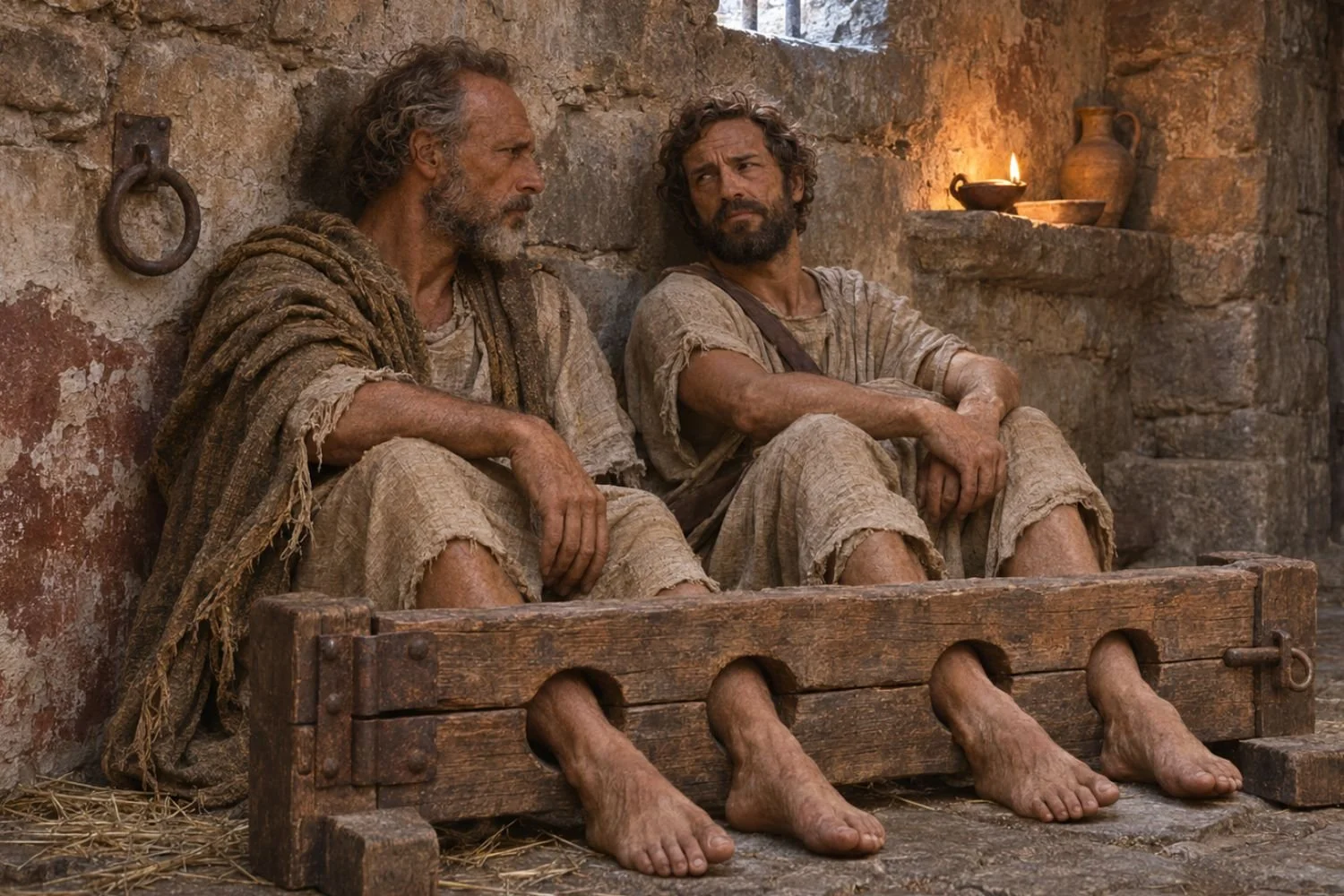
What Did a Roman Prison Look Like?
Rome didn’t maintain one standardized prison system throughout the empire. Municipal authorities used whatever secure facilities were available. Some places of detention included rooms below ground level; others occupied guarded rooms within larger civic or administrative buildings.
We don’t know the precise design or location of Philippi’s prison.
A small chamber at the archaeological site is traditionally identified as the prison of Paul and Silas, but that identification is not considered historically reliable. The room may originally have been a cistern or part of a later structure.
Acts itself gives us the most important details. The jailer was ordered to guard Paul and Silas securely. In response, he placed them in the “innermost cell” and fastened their feet in stocks.
The inner cell provided an additional layer of security. Whether it was underground, completely dark, or poorly ventilated isn’t stated. It was, however, a place from which escape was meant to be very difficult.
The Stocks
The Greek word translated “stocks” is xylon, a word that means wood or a wooden object. In this setting, it describes an apparatus used to secure a prisoner’s feet.
Stocks prevented movement. Depending on their construction, they could also force the legs into an uncomfortable or painful position. But Acts doesn’t describe the precise device or say how far Paul and Silas’s legs were spread.
We do know that the restraint came after a severe beating.
The magistrates had ordered Paul and Silas stripped and beaten with rods. Their injuries had not been treated before they were placed in confinement. Much later that night, the jailer washed their wounds.
Even if the stocks were used only as a security measure, they would’ve pressed already-injured men into an increasingly painful position. They couldn’t turn easily, stand, or find a comfortable way to rest.
Songs in the Inner Cell
At midnight, Paul and Silas were praying and singing hymns to God, and the other prisoners were listening.
Luke doesn’t tell us what Paul and Silas sang. He doesn’t describe the prisoners’ reactions or record any conversation among them. He gives us only the startling contrast of men who had been publicly humiliated, beaten, and fastened into stocks, yet were filling the prison with prayer and song.
A Roman jail was intended to secure bodies.
It could not secure their praise of God.
Then an earthquake shook the foundations of the prison. The doors opened, and everyone’s bonds came loose.
Why Did No One Escape?
When the jailer awakened and saw the open doors, he assumed the prisoners had escaped. He drew his sword and prepared to kill himself.
A guard could face severe punishment for allowing prisoners to escape. Whatever precise consequences the jailer expected, he believed his situation had become hopeless.
Then Paul called out:
“Do not harm yourself, for we are all here.”
—Acts 16:28
That single sentence raises an unanswered question.
Why were they all still there?
Acts doesn’t explain. Maybe the earthquake left the prisoners frightened and disoriented. Or darkness made escape dangerous. Maybe Paul persuaded them to remain. Or they’d been listening to his prayers and songs and now waited to see what would happen.
We cannot know.
Nor does Acts say that the other prisoners converted, confessed crimes, or chose to accept their circumstances. They remain unnamed listeners whose decision not to flee helped prevent the jailer’s death.
The detail is remarkable enough without supplying motives that Luke doesn’t give us.
The Jailer’s Reversal
The jailer called for lights, rushed inside, and fell trembling before Paul and Silas. He brought them out and asked what he must do to be saved.
Earlier, the jailer had received them as prisoners placed under his authority. Now he listened to them as people who possessed something he needed.
Paul and Silas spoke the word of the Lord to him and to those in his household. That same night, the jailer washed their wounds, and he and his household were baptized.
The reversal is physical as well as spiritual.
The man who’d secured Paul and Silas’s injured bodies now tended those injuries. He brought them into his home and placed food before them. Authority gave way to service. Fear gave way to rejoicing.
The doors opened for everyone, but Luke tells us in detail about the liberation of the man who possessed the keys.
The Prison in Oracle of Philippi
When I drafted the prison scenes in Oracle of Philippi, I had to think about details I had previously passed over: the pain of the stocks, untreated wounds, the responsibility carried by the jailer, and the vulnerability hidden beneath his authority.
The novel imagines the building, the people who moved through it, and the hours Luke leaves without describing them. Those details belong to fiction. The framework comes from Acts: an inner cell, secured feet, songs at midnight, an earthquake, open doors, and prisoners who remain.
The scene is not merely about miraculous escape.
No one escapes.
Instead, Paul remains long enough to save the life of the man responsible for holding him.
When the Door Opens
It’s tempting to read every open door as a command to run. Sometimes leaving is necessary. Remaining in an abusive or unjust situation is not automatically evidence of faith.
But Acts 16 presents a particular moment in which Paul’s freedom becomes more than his opportunity to escape. He is free enough to notice the danger facing someone else.
The prison doors open. The restraints fall away.
And Paul stays.
His deepest freedom was already present before the earthquake. It could be heard at midnight, in a place meant to contain him: He was singing.
***
Discover more of the history, culture, and beliefs surrounding Acts 16 through World Behind the Story. Subscribe to my newsletter for new articles, reflections, and occasional news about my biblical fiction.
Want to experience ancient Philippi through story? Oracle of Philippi follows the enslaved diviner, the Roman lictor who helped punish Paul and Silas, and the people caught between the claims of Rome and the call of a new faith.
