Paul’s arrival in Philippi was not the sort of event a Roman colony ordinarily noticed.
He and his companions came by way of Neapolis, the Aegean port that served Philippi. From there, they followed the road inland toward the city. The Via Egnatia passed through Philippi and extended westward toward the Adriatic and eastward toward Byzantium. Across the Adriatic, other roads continued toward Rome.
Carts and animals traveled beside them. Merchants carried goods and news between cities. Official messengers and soldiers moved along the same route.
Four men entered Philippi: Paul, Silas, Timothy, and apparently Luke, whose narration in Acts changes from “they” to “we” shortly before the journey into Macedonia.
They carried no banners. They demanded no meeting with the magistrates. As far as the colony was concerned, nothing important had happened.
But their quiet arrival would lead from a riverside gathering to the forum, from the forum to a prison, and from the prison into the homes and lives of Philippi’s first believers.
Paul’s Arrival in Acts 16
Acts records the travelers’ arrival with characteristic brevity:
“From there we went to Philippi, which is a leading city of the district of Macedonia and a Roman colony. We remained in this city for some days.”
—Acts 16:12
Luke tells us almost nothing about those first days. He doesn’t say where the men stayed, what they saw, or whom they met. Nor does he say that Paul deliberately surveyed the city before deciding upon a strategy.
The narrative resumes on the Sabbath:
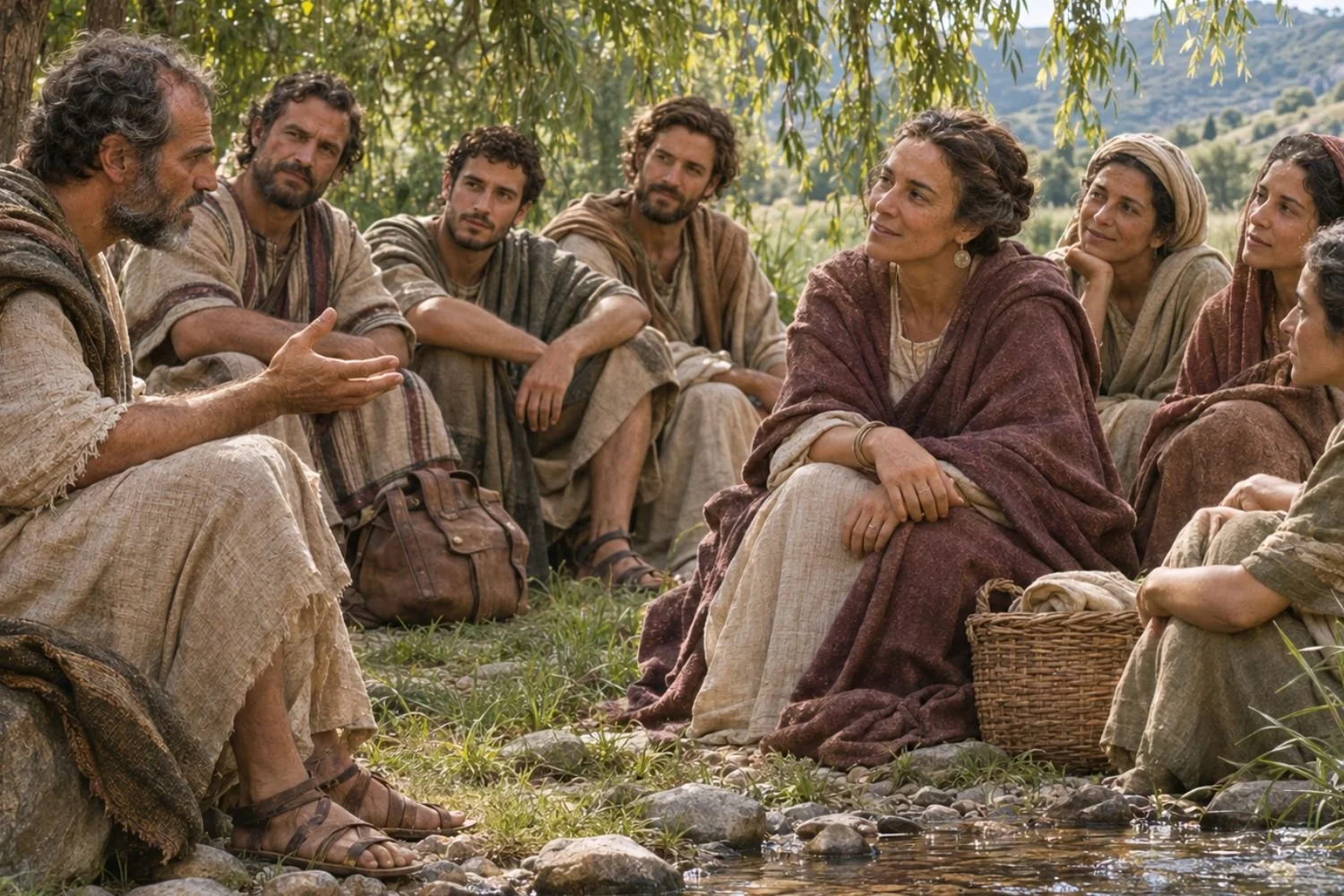
“On the Sabbath day we went outside the gate by the river, where we supposed there was a place of prayer; and we sat down and spoke to the women who had gathered there.”
—Acts 16:13
Paul did not begin in the forum before an audience of Roman citizens. He began beside a river, speaking with a group of women.
Was There a Synagogue in Philippi?
It’s often said that Philippi had no synagogue because its Jewish population included fewer than ten adult men. That explanation is possible, but it goes beyond what Acts tells us.
Later Jewish tradition required a group of ten men for certain forms of communal prayer. We shouldn’t assume that the same rule determined whether every first-century Jewish community could establish a synagogue.
Acts simply says that Paul and his companions went outside the gate to a proseuchē—a place of prayer. The Greek word could refer to a place where Jewish worshippers gathered and sometimes to a synagogue or prayer house.
Its location near water may’ve been useful for ritual washing, but Luke does not explain why the gathering met there.
So, Philippi probably did have a small Jewish community, but Paul did not find the kind of established synagogue he visited in other cities.
What Luke emphasizes isn’t what Philippi lacked, but who Paul found.
Lydia, a Seller of Purple
Among the women gathered beside the river was Lydia, a worshipper of God from Thyatira, and a seller of purple goods.
“Purple” could refer to dyes, dyed wool, cloth, or garments in a range of costly reddish-purple shades. The most famous purple dyes came from Mediterranean shellfish, but other materials could produce less expensive purple textiles. Acts doesn’t tell us precisely what Lydia sold.
Her occupation suggests commercial experience and possibly comfortable means. Acts shows us that she managed a household and owned a home where she could receive Paul and his companions.
As Paul spoke, Luke says, “the Lord opened her heart to listen eagerly.” Lydia and her household were baptized, and she urged the travelers to stay in her home.
Later, after Paul and Silas were released from prison, they returned to Lydia’s house. There they met with “the brothers and sisters” and encouraged them before leaving Philippi. By then, her home had become a gathering place for a new community.
The church in Philippi began within relationships: a conversation beside the river, a household’s baptism, and an open door.
The Arrival in Oracle of Philippi
In Oracle of Philippi, I imagine Paul’s arrival from another perspective.
Mynestra—the name I give the enslaved diviner of Acts 16—is in a temple precinct when she receives a disturbing vision. She sees strangers entering the city and senses that their presence will change Philippi. Perhaps it will change far more than Philippi.
This vision belongs to the novel, not to Acts. Scripture doesn’t say that the young woman foresaw Paul’s arrival or recognized him before she encountered his group.
The scene allows the novel to place two very different beginnings beside each other. Paul enters the colony without public notice. Mynestra, whose livelihood depends upon seeing what others cannot, perceives that something has shifted.
Lydia’s Place in the Emerging Church
Lydia stands at the beginning of the Philippian congregation’s recorded history. It’s tempting to describe her conversion as “strategic,” as though she were selected because of her money or social connections. Acts presents the encounter more personally. Paul speaks. Lydia listens. God opens her heart. She then chooses to place her household and home at the service of the new community. Her resources mattered, but so did her initiative.
She urged the missionaries to accept her hospitality. In a city ordered by citizenship, patronage, household, and status, Lydia created a place where people joined by a new allegiance could gather.
We don’t know how large her home was, or how much influence she possessed. We do know that she used what was hers to make room for others.
Quiet Beginnings, Lasting Consequences
The gathering beside the river did not remain the only setting in the Philippian story.
As Paul and his companions continued going to the place of prayer, they encountered the enslaved diviner. When Paul commanded the spirit to leave her, her owners lost their source of profit. They dragged Paul and Silas into the marketplace, where the missionaries were accused, beaten, and imprisoned.
The earthquake that followed brought another household into the emerging community: the jailer and those who lived with him.
None of this was visible when the travelers first entered Philippi.
There was only a road, an unfamiliar city, and a Sabbath gathering outside its gate.
Years later, Paul would write to the believers in Philippi with great affection. He remembered their partnership “from the first day until now.” That first day began with a few women at a river.
When Small Decisions Become Beginnings
What small arrival or decision has changed the direction of your life?
We often recognize turning points only afterward. At the time, they may look like an ordinary conversation, an unexpected meeting, an invitation offered, or perhaps a door opened to someone who needs a place to stay.
I’ve sometimes looked for the spectacular as evidence that God is at work. Yet Acts 16 reminds me that a transformation may begin before anyone recognizes its importance.
Paul came quietly to Philippi. Lydia listened. She opened her home.
And a church began.
***
In my monthly newsletter, I share selected articles from World Behind the Story, reflections, and occasional news about my writings. You’ll also receive my free Acts 16 guide when you sign up.
Browse all World Behind the Story posts.
Want to experience ancient Philippi through story? Oracle of Philippi follows the enslaved diviner, the Roman lictor who helped punish Paul and Silas, and the people caught between the claims of Rome and the call of a new faith.
Discover Oracle of Philippi
