It’s easy to dismiss ancient oracles as relics of a superstitious age. But that leaves an interesting question unanswered:
Why did people capable of sophisticated reasoning take them seriously?
The Greeks who consulted oracles belonged to a world that produced enduring philosophy, literature, mathematics, and scientific inquiry. Asking difficult questions about nature and human life didn’t necessarily lead them to reject the gods—or the possibility that those gods communicated.
For many, these pursuits belonged together.
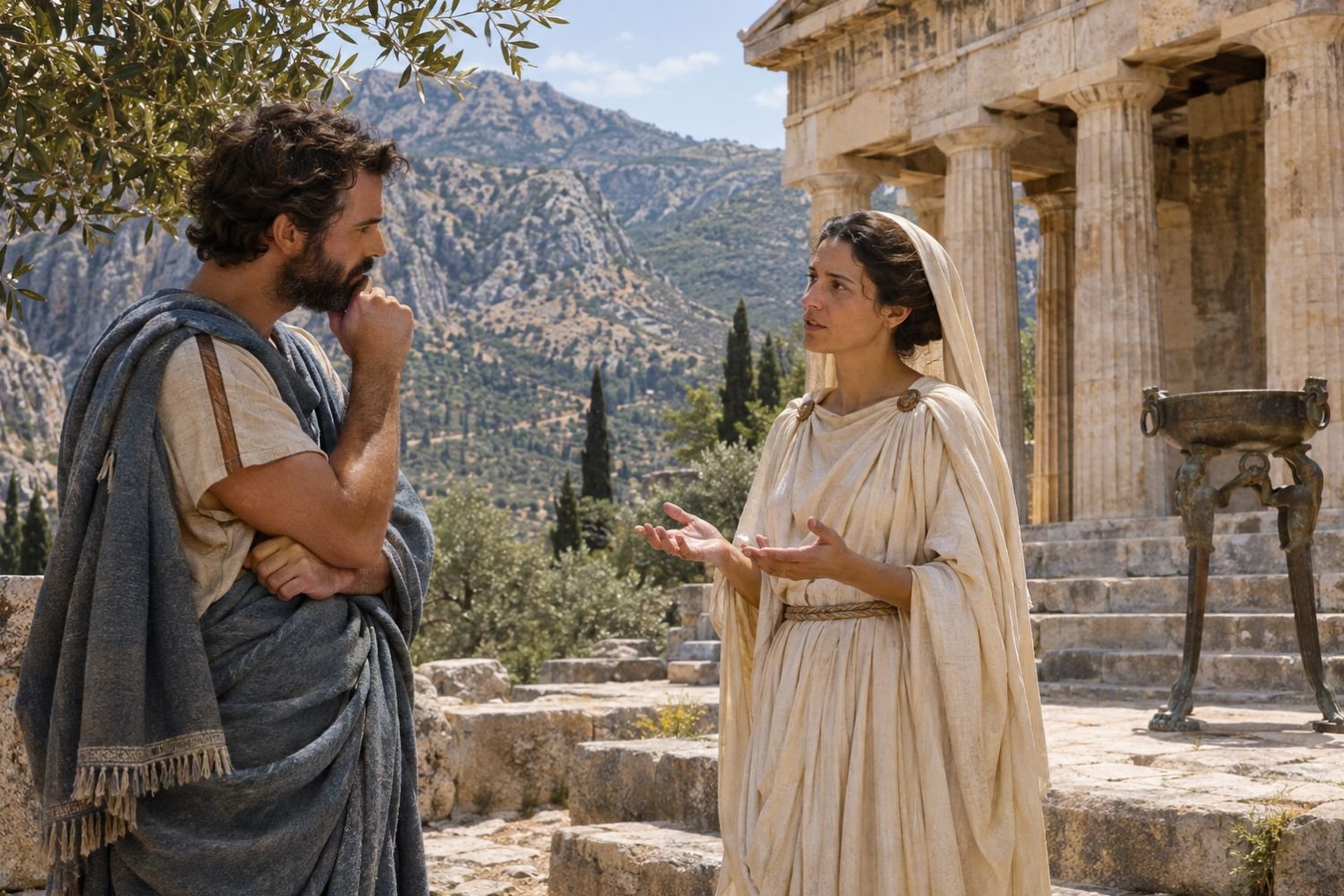
A Thoughtful Visit to Delphi
A World Alive with Spiritual Powers
For many Christian readers, the idea that unseen spiritual beings influence human affairs won’t seem strange. We believe in God, and many of us also believe in angels and demons. We pray for guidance and trust that human knowledge doesn’t encompass everything.
That gives us a point of connection with ancient people, even where our beliefs differ.
The Greeks who consulted oracles lived in a world they understood to be shaped by many gods. Those gods could influence harvests, storms, wars, diseases, dreams, and the fortunes of cities. If divine beings shaped human affairs, it made sense to ask what they intended.
An oracle offered one way of seeking an answer.
A city considering war might weigh its military strength, examine its alliances, and consult a god. People preparing to establish a settlement overseas might need practical information about the destination, but they might also want assurance that the undertaking had divine approval.
Human judgment mattered. It simply wasn’t assumed to encompass everything that mattered.
Within that understanding of reality, seeking divine guidance could seem a responsible response to uncertainty. The questions were which powers to trust—and where to go to hear them.
Knowledge Beyond Human Sight
Uncertainty has always driven people to seek answers.
Today we consult physicians, economists, political analysts, weather forecasts, and computer models. These sources use very different methods from ancient divination, but the desire to make a wise choice under uncertain conditions is familiar.
Ancient Greeks also sought practical advice and people with specialized knowledge. Yet many believed the gods knew things no human expert could discover.
An oracle might disclose that hidden element: a divine intention, an offense requiring attention, or a danger beyond human sight.
The question wasn’t simply, “What will happen?”
It might also be, “What should we do—and what do the gods require of us?”
At Delphi, those questions brought religion, politics, tradition, and human uncertainty together. Apollo’s sanctuary drew people from across the Greek world and beyond. Its influence changed over the centuries, but its long history gave it an authority few individuals could claim.
People came to a place that generations before them had trusted. Its reputation, sacred traditions, and recognized place in public life could make consultation seem reasonable—even prudent.
Trust Didn’t Exclude Questions
That trust wasn’t universal or uncritical.
Ancient accounts preserve stories of disappointing responses, disputed interpretations, and accusations of manipulation. Comic writers mocked diviners and people who traded in prophecies. Belief in divine communication didn’t require confidence in every person who claimed to speak for a god.
An oracle’s answer could also begin a debate rather than end one.
In Herodotus’s account of the Persian invasion, the Athenians received an oracle promising protection through a “wooden wall.” What did that mean? A defensive barrier? Their ships?
Themistocles argued for the ships.
Whatever we can reconstruct about the consultation itself, the account shows people reasoning about an oracle’s meaning. They weighed words, challenged interpretations, and argued over what action to take.
Trust in an oracle could leave considerable room for human judgment.
For Christian readers, that distinction may feel familiar. Believing that God guides people doesn’t mean accepting every claim that someone speaks for him. We still ask questions about the messenger, the message, and the grounds for trusting either.
The Greeks asked such questions within a different religious framework, but their willingness to consult an oracle didn’t mean they had stopped thinking.
Hearing Acts 16 in Its Own World
Recognizing this helps us read the New Testament with fresh eyes.
Paul’s encounter with the enslaved girl in Acts 16 wasn’t a confrontation between someone who believed in spiritual powers and someone who didn’t. Paul himself believed in spiritual powers. The question was whose power was at work—and what authority it held.
Luke describes the girl as having a “spirit of Python,” language that evoked the oracular tradition associated with Delphi and Apollo. That wording doesn’t tell us she served at Delphi or belonged to one of Apollo’s temples. It does help us understand the religious world in which people might have interpreted her abilities.
Her owners profited from her divination. People were willing to pay for what they believed she could tell them.
To those customers, seeking her guidance may have seemed a sensible way to face something uncertain: a journey, a business decision, or a fear about the future. Luke doesn’t tell us what they asked. But the desire to know what lies beyond our sight is easy enough to recognize.
When Paul commands the spirit to leave her in the name of Jesus Christ, the narrative turns on spiritual authority. The existence of a spiritual world is already assumed; the source of this particular voice is what matters.
We don’t have to share the beliefs of those who consulted oracles to understand why they sought answers. Nor does understanding their reasoning require us to accept every spiritual claim as trustworthy.
History becomes more interesting when we stop asking, “How could they believe that?” and begin asking, “Given what they believed about reality, why did this make sense to them?”
***
What changes when we read Acts 16 with its ancient setting in view? My free guide explores the history and culture behind Paul’s arrival in Philippi—and the people whose lives he encountered there.
Sign up for my monthly newsletter and get the free Acts 16 guide.
