In Oracle of Philippi, a young woman steps forward in a temple precinct. Her saffron chiton falls in measured folds. A bronze serpent coils around her wrist. The gathering quiets, waiting for her to speak.
Her name is Mynestra.
That scene belongs to the novel. Acts doesn’t name the enslaved diviner Paul encounters in Philippi, describe her clothing, or place her in a temple. But Luke’s expression for the spirit within her opens a door into the religious world surrounding her.
He calls it a “spirit of Python.”
To understand the association, we must travel beyond Philippi—to Apollo’s sanctuary at Delphi.
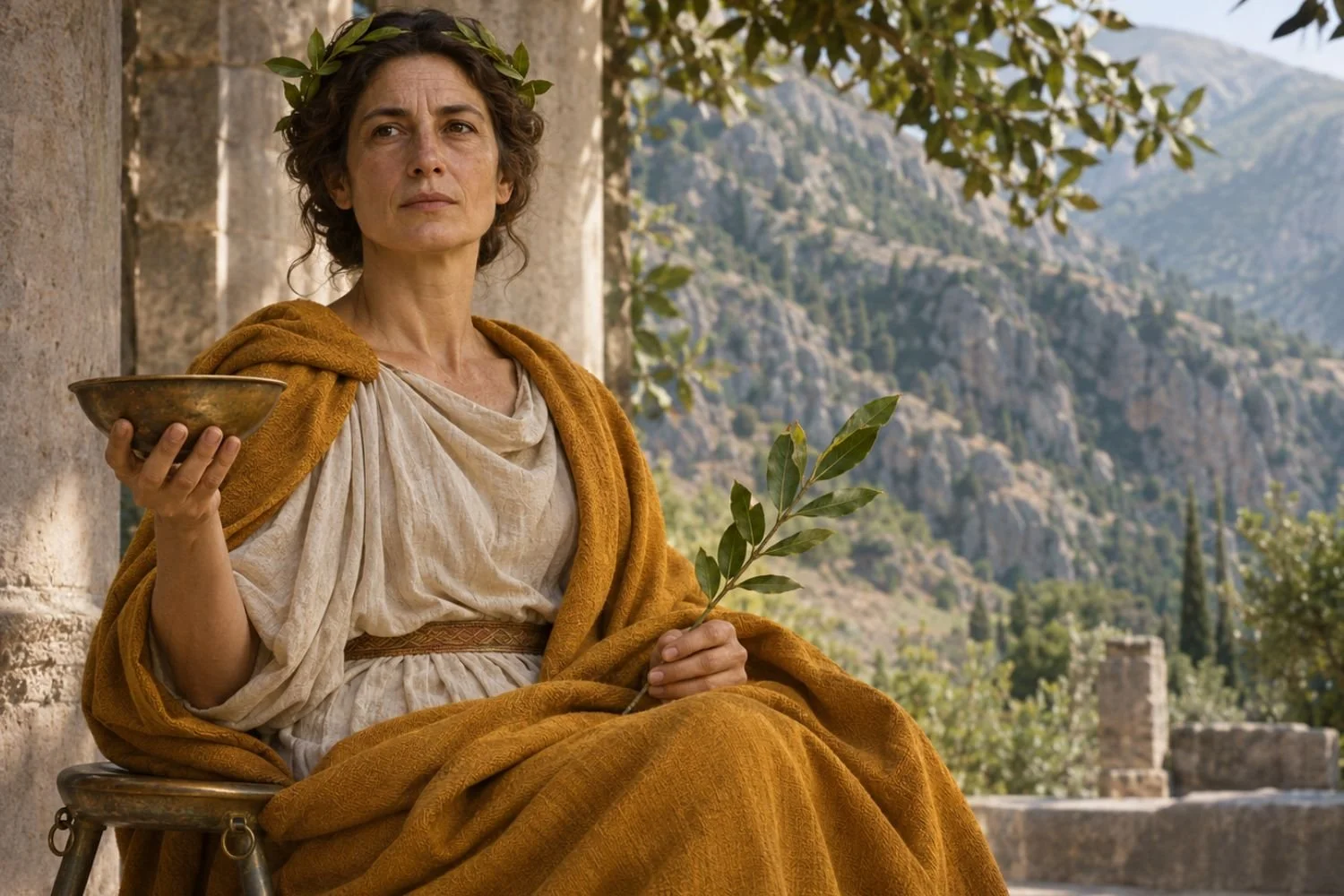
Delphic Pythia in Saffron, wearing a laurel crown
A Sanctuary Built Around a Voice
Delphi lay on the slopes of Mount Parnassus in central Greece. Visitors approached Apollo’s temple along the Sacred Way, passing monuments and treasuries that displayed the offerings and ambitions of Greek communities.
The setting gave a question weight before anyone answered it. People came to a sanctuary whose buildings, gifts, and accumulated history testified that generations before them had sought guidance there.
At the heart of the oracle stood the Pythia, Apollo’s priestess.
Individuals and representatives of cities sought divine counsel through her. Their questions could concern public decisions, religious obligations, or private uncertainty. What should they do? Which course should they take? How could they act without offending the gods?
The Pythia’s authority rested on the belief that her answers carried a wisdom beyond ordinary human judgment.
Apollo, Python, and the Name That Remained
Greek traditions told different stories about the beginnings of the sanctuary. In the familiar account, Apollo killed the serpent or dragon Python and established his claim to the sacred place.
The defeated creature’s name remained closely associated with the victorious god. Apollo was known as Pythian Apollo, and his prophetic priestess as the Pythia.
That association helps explain why Luke’s wording matters.
“Spirit of divination,” the expression found in many English translations of Acts 16:16, tells us what the spirit enabled the young woman to do. “Spirit of Python” also preserves a cultural association: the world of Apollo and inspired oracular speech.
It doesn’t establish a direct institutional connection between Delphi and Philippi. It gives us a glimpse of the religious language through which such a voice could be recognized.
The serpent wasn’t the only creature associated with Apollo. In What Crows Meant in the Ancient World, I explore another of his animal connections—and why I gave Mynestra a crow named Sylvanus.
More Than Mysterious Riddles
Popular accounts often reduce Delphi to a woman speaking incomprehensible words while priests turn them into riddles.
The surviving evidence is more complicated.
Consultation took place within an organized sanctuary, with religious preparations, offerings, and attendants. Yet the precise delivery of the Pythia’s responses, and the involvement of others in presenting them, remain subjects of debate.
Ancient writers themselves discussed how divine inspiration worked. Plutarch’s dialogue commonly known as The Oracles at Delphi considers, among other questions, why responses were no longer ordinarily delivered in verse. The oracle had a history, and its practices couldn’t be reduced to a single unchanging performance.
For someone seeking guidance, however, the central concern was practical. A decision had to be made. The oracle offered access to an authority believed to see farther than the person asking.
That helps us understand why divining speech could attract attention—and paying clients—far beyond Delphi.
From Delphi to Philippi
The young woman in Acts wasn’t identified as the Pythia. Luke doesn’t say she trained at Delphi, belonged to its priesthood, or served in a comparable sanctuary.
Python terminology could extend beyond Delphi’s own institution. Its use in Acts therefore suggests a cultural connection without supplying an occupational biography.
The distinction matters: Delphi helps us understand the associations surrounding her voice. It cannot tell us where she stood when clients approached, what she wore, or how her owners presented her.
Acts gives us a different kind of certainty. Her divination brought her owners considerable income.
When Paul commands the spirit to leave her in the name of Jesus Christ, it leaves immediately. Her owners then seize Paul and Silas because their hope of profit has disappeared. Luke’s account moves from her voice to their grievance, and then into the public conflict that leads to imprisonment.
I explore that encounter more fully in The World Behind Luke’s “Spirit of Python.”
Imagining Mynestra
For Oracle of Philippi, Delphi helped me imagine how an oracular voice might acquire religious authority in the eyes of those who heard it.
Mynestra’s clothing, serpent jewelry, and ritual appearances belong to that fictional reconstruction. Her owners carefully cultivate the public’s expectations because belief in her voice brings them money and influence.
Delphi supplied part of the cultural background. Acts supplied the encounter that changes her life.
Between them lay the work of fiction: imagining a young woman who must discover who she is when people can no longer come to her for answers.
***
What happened to the unnamed young woman after Paul commanded the spirit to leave her? That unanswered question became the starting point for Oracle of Philippi, my biblical historical novel.
Meet Mynestra in Oracle of Philippi.
For more history behind the biblical world, subscribe to my monthly newsletter and receive The Hidden World Behind Acts 16, my free reader’s guide.
