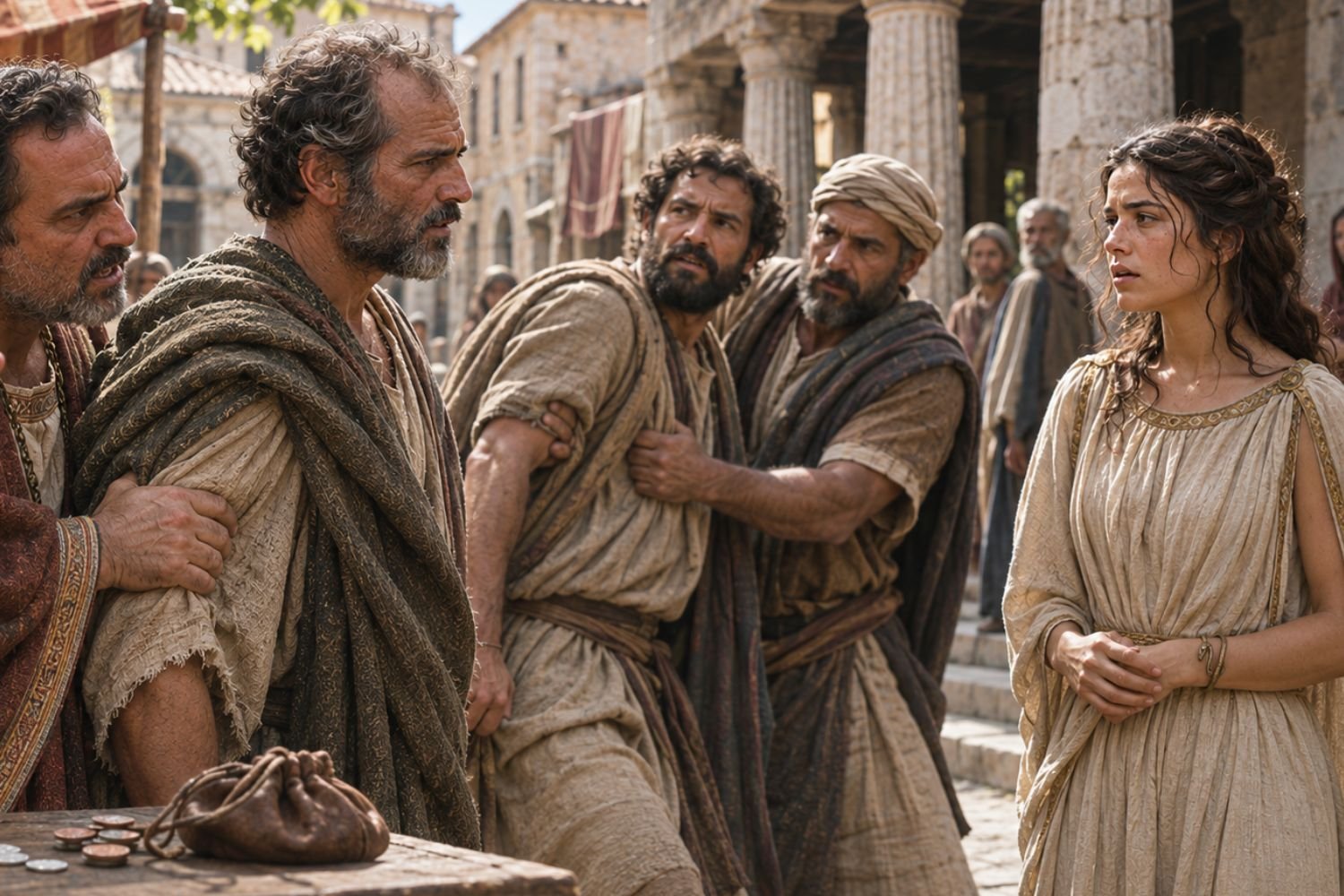
Imagine entering Philippi’s forum in the middle of a working day.
Magistrates conduct public business. Petitioners wait for a hearing. Merchants negotiate beneath covered walkways. Citizens stop to exchange news. Enslaved workers carry messages, purchases, and goods through the square.
Above the bargaining merchants and knots of townspeople, statues of emperors and honored citizens stood on stone pedestals, their inscriptions proclaiming Rome’s power and the city’s loyalties. Voices and footsteps filled the square beneath their gaze, while columns and public buildings gave the bustle a frame of Roman order.
The forum wasn’t simply a marketplace. It was the civic heart of the Roman colony. The place where government, commerce, religion, and public reputation met.
It was also where Paul and Silas were dragged before the authorities in Acts 16.
Agora or Forum?
Acts uses the Greek word agora for the place where the owners of the enslaved diviner took Paul and Silas. The word can mean a marketplace, public square, or civic gathering place.
In a Roman colony such as Philippi, the corresponding Latin term was forum. It was the public center where the colony displayed and conducted its Roman identity.
The distinction isn’t a simple choice of words—Greek agora versus Roman forum. Philippi had a public gathering place before the Romans arrived, and its civic center changed over time. But the change was Roman, as Roman builders gradually reshaped the area around the Via Egnatia.
By the middle of the first century, when Paul visited Philippi, the colony was developing, or had recently developed, a monumental Roman forum. Administrative, religious, and commercial spaces bordered its public square.
Most of the imposing ruins visitors see today, however, reflect renovations made after Paul’s lifetime, mostly during the second century. The forum of Acts 16 occupied this civic landscape, but archaeologists can’t place every surviving column, building, or platform in Paul’s day.
The great Christian churches whose ruins dominate parts of the site—including Basilica A and Basilica B—belong to a much later period, the fifth and sixth centuries. They bear witness to the Christian community that flourished in Philippi centuries after Paul’s small gathering by the river first took root.
The Public Heart of the Colony
In any Roman colony, the forum made authority visible.
The colony’s chief magistrates conducted civic business there. Decrees and official announcements were presented publicly. Religious monuments expressed the city’s obligations to its gods and benefactors. Inscriptions preserved names, honors, offices, and gifts for anyone able to read them.
Commercial activity took place in and around the civic center. Shops and market areas brought together residents from different levels of Philippian society: citizens and foreigners, patrons and clients, free workers and enslaved laborers.
A person’s standing could be recognized or destroyed in the forum.
A respected citizen might be honored before a crowd. An accused person might be dragged before the magistrates, exposed to the crowd’s accusations, then stripped and beaten with rods in full view of the square.
At a magistrate’s command, the lictors could lead the battered prisoner away—a visible demonstration that the authorities had acted, and that resistance carried a steep cost.
Justice Before an Audience
Roman law contained procedures and protections, especially for citizens. But local justice didn’t always unfold as an orderly investigation of evidence.
Crowds mattered. Social standing mattered. Ethnicity mattered. The desire of magistrates to restore calm could matter more than determining what had actually happened.
Public punishment reinforced this authority. A beating did not affect only the body of the person receiving it. It humiliated the accused before witnesses and warned others against similar disruption.
The punishment said: this is what happens to those who disturb the colony.
That is the world behind the marketplace scene in Acts 16.
Paul and Silas in the Forum
After Paul commands the spirit to leave the enslaved diviner, her owners realize that their hope of profit is gone.
They seize Paul and Silas and drag them into the marketplace before the rulers:
“When they had brought them before the magistrates, they said, ‘These men are disturbing our city; they are Jews and are advocating customs that are not lawful for us as Romans to adopt or observe.’”
—Acts 16:20–21
The accusation is carefully framed.
The owners’ actual financial loss disappears from their public argument. They don’t complain that Paul has destroyed their income. Instead, they identify Paul and Silas as Jews and accuse them of threatening Roman customs.
The charge appeals to prejudice, civic pride, and fear of disorder.
The crowd joins the attack. The magistrates respond without establishing whether the accusations are true and without asking whether the accused possess Roman citizenship. Paul and Silas are stripped, beaten with rods, and imprisoned.
Acts doesn’t describe a formal trial followed by a legal verdict. Instead, it shows something more alarming: accusation, crowd pressure, and punishment moving forward with frightening speed.
The forum, designed to represent Roman justice, becomes the setting for its failure.
The Magistrates’ Mistake
Only the following morning does Paul reveal that he and Silas are Roman citizens.
“They have beaten us publicly, uncondemned, men who are Roman citizens, and have thrown us into prison; and now are they going to discharge us in secret?”
—Acts 16:37
Paul and Silas had suffered a public beating, a public humiliation, before the colony without a lawful hearing. The magistrates tried to quietly release them and pretend that nothing improper had happened, but Paul didn’t allow them to get away with it.
He demanded that the magistrates themselves come and escort them out.
The officials who’d used the forum to display their authority were now compelled to acknowledge, before others, that they had misused it.
The Forum in Oracle of Philippi
In Oracle of Philippi, the forum is one of the places where the city becomes almost a character in its own right.
Roman identity is performed there. Clement Florus and the other lictors precede the magistrates through the public square, carrying the bundled rods that represent their authority. Citizens recognize who possesses power and who must step aside.
The day before, when Paul and Silas were dragged before the magistrates, Clement saw the crowd pressing for immediate action. He heard the accusation that the Jewish strangers were disturbing a Roman city. He received the order to beat them.
Acts doesn’t name the lictors who administered the punishment or tell us how any of them regarded what they had been commanded to do.
Clement is my fictional entry into that silence.
For him, the forum had always represented stability, law, and honor. The beating forces him to consider a possibility he has resisted:
Rome’s authority and justice are not always the same thing.
When Public Order Replaces Justice
The forum was built to embody civic order. Yet Acts 16 shows how easily the demand for order can overwhelm the requirements of justice.
The owners protect their profit by changing the reason for their outrage. The crowd amplifies the accusation. The magistrates act quickly. The lictors obey.
Each participant has a reason for doing what he does. Together, they punish two men who have not been properly heard.
Rome’s authority was displayed in the forum every day.
On this day, so was its failure.
***
In my monthly newsletter, I share selected articles from World Behind the Story, reflections, and occasional news about my writings. You’ll also receive my free Acts 16 guide when you sign up.
Browse all World Behind the Story posts.
The fictional lictor Clement Florus witnesses Roman justice fail in the forum he has always honored. His struggle between duty and conscience lies at the heart of Oracle of Philippi.
