In Thessalonica, opponents recruit men from the marketplace and set the city in an uproar.
In Ephesus, a dispute involving a profitable trade spreads into a theater filled with shouting people. Many don’t even know why they’ve gathered.
In Jerusalem, an assumption about Paul becomes an accusation that nearly costs him his life.
Acts repeatedly shows opposition spreading beyond the people who first raise a complaint. New participants bring their own fears and loyalties. The accusation becomes easier to repeat than to examine.
In each case, the disturbances have different beginnings, and the officials respond differently. Together, they raise a persistent question:
What happens to someone when the crowd decides what they represent before hearing what they’ve done?
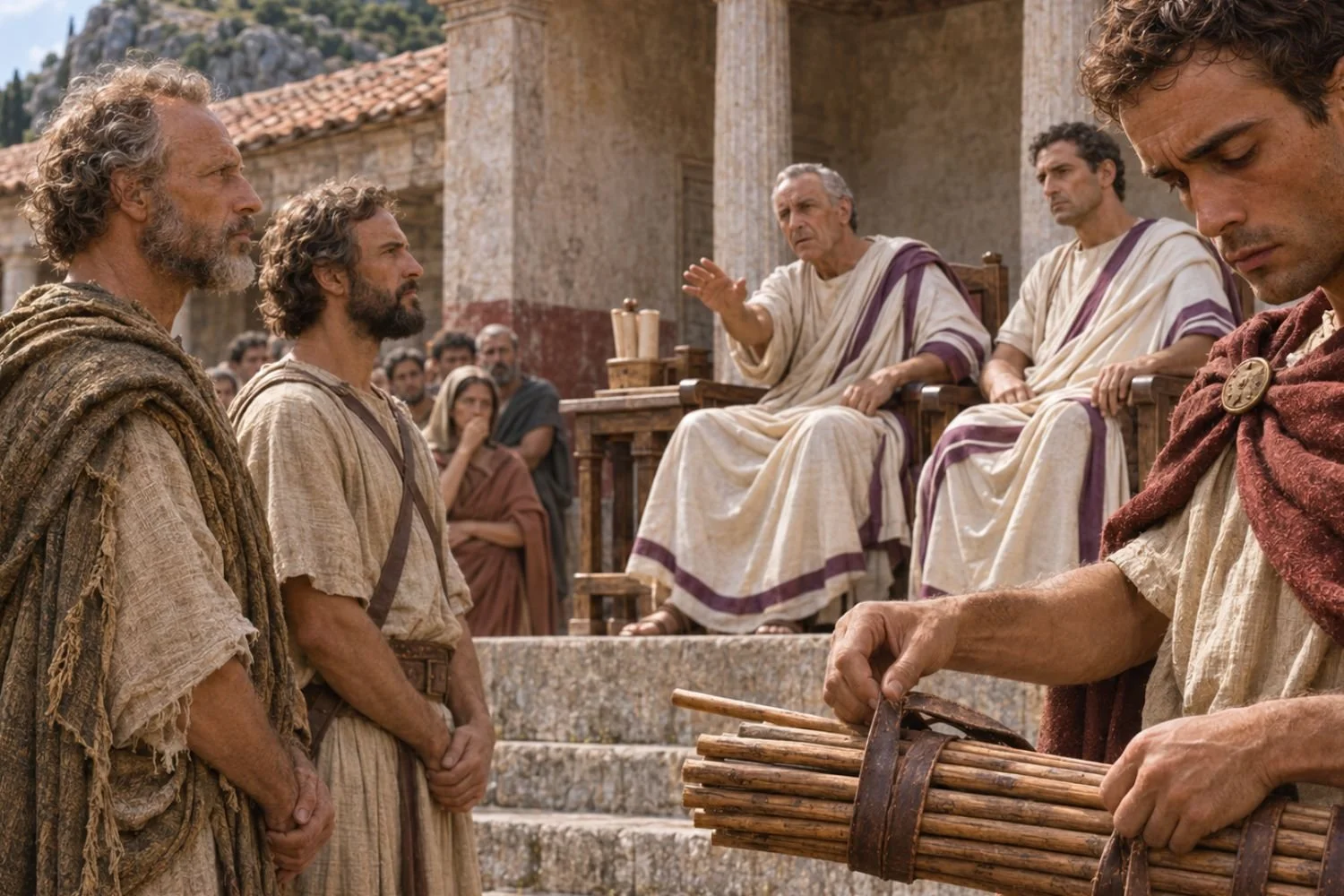
Thessalonica: Someone Assembles the Mob
Paul’s teaching in Thessalonica persuades some synagogue listeners, including God-fearing Greeks and prominent women, but others become hostile.
Acts describes opponents recruiting men from the marketplace, forming a mob, and throwing the city into confusion. They rush to the house of a believer named Jason, looking for Paul and Silas.
Unlike in Philippi, which resulted in simple mob action, this gathering has organizers.
When the missionaries can’t be found, Jason and other believers are dragged before the city officials. The accusation gives the disturbance a politically dangerous meaning, that these people are acting against Caesar’s decrees and proclaiming another king, Jesus.
A dispute over Paul’s teaching has become a question of imperial loyalty.
Jason must answer for hosting the men whom the crowd wants. The officials obtain security from him and the others before releasing Paul and Silas. Acts doesn’t specify the conditions, but the believers send the missionaries away that very night.
Hospitality has become a liability.
Ephesus: A Grievance Becomes a Chant
In Ephesus, Demetrius gathers fellow craftsmen whose income depends on making silver shrines of Artemis.
He begins with their livelihood, since Paul’s teaching threatens demand for what they produce.
Then he broadens the danger. Their trade may lose its standing. Artemis’s temple may be discredited. The goddess’s magnificence may be diminished.
These concerns reinforce one another. Income, religious devotion, and civic pride become parts of the same appeal.
The disturbance spreads into the theater. Paul’s companions Gaius and Aristarchus are dragged along, although Paul himself is absent. His friends have prevented him from entering.
Inside, people shout conflicting things. Luke observes that most don’t even know why they’re there. They’ve joined an event whose original grievance they may never have heard.
They begin chanting, reinforcing their common identity: “Great is Artemis of the Ephesians!” But it doesn’t explain what Paul has done wrong or why the silversmiths are angry. It simply declares their devotion to Artemis and their pride in Ephesus.
The City Clerk Changes the Question
The Ephesian city clerk quiets the gathering by addressing what its members fear.
He reassures them about their city’s standing as guardian of Artemis’s temple. Then he distinguishes their anger from an actionable accusation.
The men brought into the theater, he says, are neither temple robbers nor blasphemers of their goddess. If Demetrius has a complaint, legal channels are available. Other civic business belongs in a lawful assembly.
The gathering itself could now expose the city to a charge of rioting. They could be called to account for the disturbance and have no justification for it (Acts 19:40). Luke doesn’t specify the possible penalty, but Roman intervention could threaten the city’s privileges and freedom to manage its own affairs.
Having turned their attention from defending Artemis to answering for their own conduct, the town clerk dismisses the assembly.
Jerusalem: An Assumption Becomes a Fact
In Jerusalem, some Jews from the province of Asia see Paul in the temple and stir up the people.
They accuse him of teaching against the Jewish people, the law, and the temple. They also allege that he has brought Greeks into the temple and defiled it.
Luke explains the inference behind that charge. They had previously seen Trophimus, an Ephesian Gentile, with Paul in the city and assumed Paul had brought him into the temple.
Something observed in one location becomes a claim about what happened in another.
The accusation spreads. Paul is seized, dragged out of the temple, and beaten. His attackers are trying to kill him when Roman troops intervene.
Luke records no verification of Trophimus’s supposed presence in the restricted precinct.
The crowd acts on the allegation.
Uproar Makes the Truth Harder to Establish
The Roman commander arrests Paul and tries to discover who he is and what he’s done. Conflicting answers rise from the crowd. Unable to establish the facts amid the noise, he orders Paul taken into the barracks.
The intervention saves Paul’s life, but the commander also has mistaken assumptions. He initially wonders whether Paul is an Egyptian insurgent.
Even this man, who is attempting to restore order, must discover who he has detained.
Paul eventually receives permission to address the people. They listen for a time, then erupt again when he describes being sent to the Gentiles.
What These Disturbances Share
In each case, the grievance becomes attached to something larger than the immediate dispute.
In Thessalonica, opposition to Paul becomes an accusation of disloyalty to Caesar.
In Ephesus, threatened earnings become a defense of Artemis and her city.
In Jerusalem, an unverified assumption becomes a charge of temple defilement.
Philippi followed a related pattern. The owners’ loss of income is presented as a threat to Roman customs, and the crowd joins the attack. There, the magistrates turn public hostility into punishment.
All of the accusations gain force because they touch loyalties people already hold.
Participants may believe they are protecting something sacred or necessary. That can make checking the allegation feel less urgent than responding to it.
Who Disappears Inside the Accusation?
Jason becomes answerable for the missionaries he has welcomed.
Gaius and Aristarchus are seized during a disturbance directed at Paul’s influence.
Paul becomes a temple defiler on the strength of an inference.
Each person is treated as a representative of a feared movement or offense. His particular actions become harder to distinguish from the meaning assigned to him.
That’s one of the losses these scenes expose: the accused person’s own account struggles to enter the story the crowd is already telling.
Before We Join the Uproar
Acts doesn’t make every gathering suspect. Public grievances can be legitimate. Conversely, formal proceedings can also produce injustice.
These episodes reveal more specific failures: recruiting anger, repeating an allegation without checking it, joining a gathering without understanding its purpose, and treating heightened feelings as evidence.
The Ephesian clerk shows that someone can interrupt the process. He brings an expanding disturbance back to particular allegations and appropriate procedures.
For readers, the questions are equally concrete.
What do we know firsthand? What have we inferred? Why are the original accusers angry? Have we heard from the person being accused?
A conviction shared by a crowd can feel settled long before it has been examined.
Acts repeatedly lets us see the distance between those two things.
Scripture for Further Reading
Acts 16:19–24
Acts 17:1–9
Acts 19:23–41
Acts 21:27–22:22
***
Discover more of the history, culture, and beliefs surrounding Acts 16 through World Behind the Story. Subscribe to my newsletter for new articles, reflections, and occasional news about my biblical fiction.
Want to experience ancient Philippi through story? Oracle of Philippi follows the enslaved diviner, the Roman lictor who helped punish Paul and Silas, and the people caught between the claims of Rome and the call of a new faith.
