In Acts 16, the magistrates order Paul and Silas stripped and beaten with rods. After receiving many blows, the two men are taken to prison, where their feet are fastened in stocks.
Luke records no examination of witnesses, no defense offered by the accused, and no judgment establishing their guilt. His account moves directly from accusation and public hostility to official punishment.
The following morning, Paul declares that both he and Silas are Roman citizens. The magistrates should have examined the accusations and allowed them to answer before passing judgment.
Instead, they’d ordered a public beating without a lawful hearing—violating the protections their citizenship afforded them.
Why would the officials of a Roman colony have allowed this?
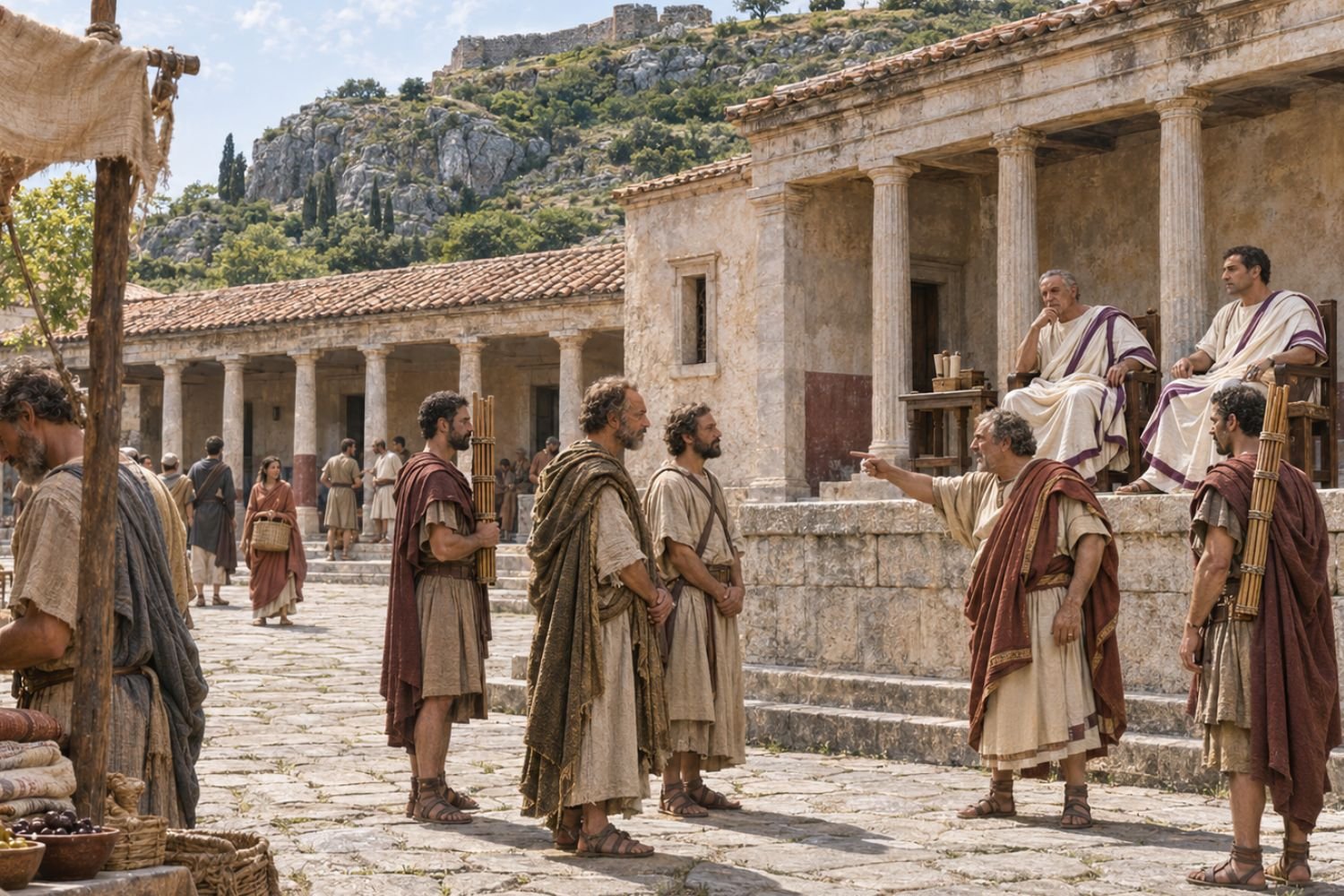
An Accusation That Demanded Attention
If you are unfamiliar with Acts 16, the trouble begins after Paul commands a spirit to leave an enslaved diviner, and her owners recognize that she can no longer be counted on to produce income for them.
They seize Paul and Silas and bring them before the authorities. The owners’ public complaint doesn’t concern the girl’s welfare or their lost earnings. Instead, they identify the missionaries as Jews who are disturbing the city and advocating customs Romans should not accept.
They’re presenting a private loss as a problem of civic order.
When the crowd joins the attack, the magistrates respond by ordering corporal punishment. Whatever inquiry may’ve occurred beyond Luke’s account, Paul’s later protest makes clear that they were punished without a hearing and a judgment.
Who Had the Authority to Order a Beating?
Philippi was a Roman colony, with civic institutions modeled on Roman government. Its two chief magistrates, commonly called duumviri, administered local affairs and justice.
Luke calls them strategoi, a Greek term used here for the colony’s leading officials.
They were assisted by men Luke calls rhabdouchoi: rod-bearers, generally understood as lictors. These attendants carried the fasces, bundles of rods that represented a magistrate’s coercive authority.
Their work could include maintaining order, carrying official messages, and carrying out punishment. They probably administered the beating ordered in Acts 16, although Luke does not explicitly identify the men who struck the blows.
The rods made authority visible. They could also make it painfully physical.
Punishment as a Means of Keeping Order
Roman officials possessed powers to compel obedience and suppress disorder, often discussed under the term coercitio. The extent of those powers varied according to the office, jurisdiction, and legal status of the person involved.
Maintaining public order was an important responsibility. An official could regard a swift arrest or beating as an effective response to people believed to be causing trouble.
That helps explain the setting, but it doesn’t establish the magistrates’ precise thoughts.
They may’ve regarded punishment as the quickest way to quiet the disturbance. They may’ve accepted the accusers’ description of the missionaries without sufficient inquiry. Luke doesn’t tell us.
But he shows the result. The officials punish first and discover the men’s citizenship afterward.
What Does “Without a Trial” Mean?
The Greek word used in Paul’s protest is akatakritos: uncondemned, or without a judgment against someone.
We shouldn’t picture a modern courtroom and assume that Roman proceedings followed the same requirements. Local justice could be brief, unequal, and strongly influenced by status.
Nevertheless, Paul’s objection is solid. He and Silas have received a degrading public punishment without a judgment establishing their guilt, despite possessing Roman citizenship.
His complaint concerns the treatment itself and the legal standing the magistrates have disregarded.
Why Citizenship Changed the Situation
Roman citizenship carried significant legal protections that had developed over centuries through laws and traditions limiting arbitrary punishment and providing avenues of appeal.
Citizenship did not make someone immune from arrest or prosecution. Nor did Roman officials always respect the protections attached to it.
But the public beating of uncondemned citizens was a serious matter.
Cicero’s prosecution of Verres, a former governor of Sicily, illustrates the force of the citizenship claim. Among the abuses he described was the flogging of a man who repeatedly declared that he was a Roman citizen. The scandal lay in an official treating that status as though it offered no protection.
Acts presents a related situation in Jerusalem. When Paul is about to be interrogated by flogging, he asks whether it is lawful to flog an uncondemned Roman citizen. The preparations stop.
In Philippi, the discovery comes after the blows.
Why Didn’t Paul Speak Earlier?
Acts does not explain why Paul’s citizenship becomes decisive only the following morning.
Perhaps Silas and he didn’t have an opportunity to speak. Perhaps an earlier protest was ignored. Perhaps Paul chose that moment to assert their rights.
Each explanation is possible, and none is supplied by Luke.
But because of that, we should avoid saying that Paul deliberately concealed his citizenship to create a confrontation later. We should also avoid assuming that the officials could reliably recognize citizenship from someone’s clothing, occupation, or ethnicity.
A Jewish traveler could also be a Roman citizen. The categories weren’t mutually exclusive.
Whatever happened during the disturbance, the magistrates acted without recognizing the legal status of the men before them.
The Officials Discover Their Mistake
The next morning, the magistrates send instructions for Paul and Silas to be released. Paul refuses a quiet dismissal, insisting that the officials come themselves.
When the magistrates learn that both men are Roman citizens, they become fearful. They come to the prison, placate them, bring them out, and ask them to leave Philippi.
Acts doesn’t say which penalties the magistrates feared. A complaint about their treatment of Roman citizens could plausibly threaten their standing or expose them to proceedings before higher authorities.
Their conduct had also contradicted the identity their colony cherished. They had acted as guardians of Roman order while disregarding protections associated with Roman citizenship.
Authority Before Inquiry
The beating in Philippi reveals how dangerous summary authority could become when officials acted on accusations without establishing the position of the accused.
Paul and Silas were vulnerable to the magistrates’ immediate power though they possessed rights that should’ve mattered.
Those rights did not prevent the punishment, and only became consequential when Paul required the officials to confront what they’d done.
The rods carried through Philippi represented civic authority. In this encounter, their use exposed a failure within that authority.
The officials had the power to inflict punishment, but they had not established their right to inflict it on these men.
Sources and Further Reading
Acts 16:16–40; Acts 22:22–29
Cicero, Against Verres, Book 2.5
***
In my monthly newsletter, I share selected articles from World Behind the Story, reflections, and occasional news about my writing. You’ll also receive my free Acts 16 guide when you sign up.
Browse all World Behind the Story posts.
Want to experience ancient Philippi through story? Oracle of Philippi follows the enslaved diviner, the Roman lictor who helped punish Paul and Silas, and the people caught between the claims of Rome and the call of a new faith.
